Technical Surveillance Counter Measures (TSCM) Services
Technical surveillance countermeasures (TSCM), also known as bug sweeping, assess spaces and equipment for signs of covert surveillance.
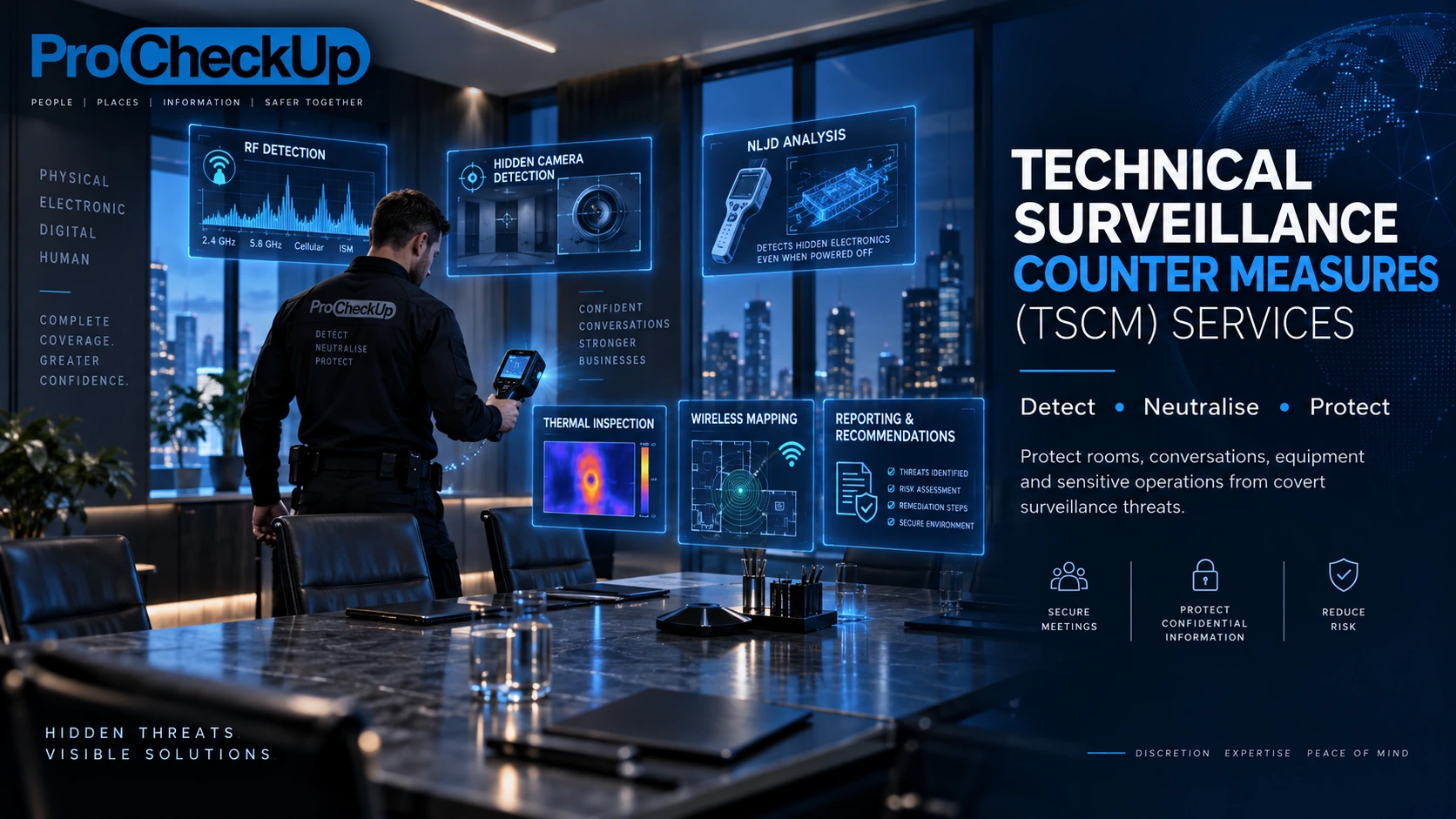
ProCheckUp’s UK-based TSCM services detect and neutralise covert surveillance threats—including hidden microphones, wireless transmitters, unauthorised cameras, and electronic intrusions—across physical, electronic, and digital dimensions.
Trusted by high-security facilities, legal firms, government teams, and private offices across the UK.
Discuss a confidential TSCM survey. Use the initial enquiry to arrange a suitable contact and agree a channel for sensitive details.
When a TSCM survey may be useful
Before sensitive board meetings, negotiations or other discussions where the location needs assessment.
After changes to a room, occupancy or equipment create a specific surveillance concern.
When reviewing offices, meeting spaces or other authorised areas as part of a wider security programme.
View the sample TSCM presentation (PDF) for an introduction to TSCM
Scoping a TSCM survey
Describe the concerns and the decisions you need to make. The purpose, access and conditions of a survey determine what can be examined; a survey cannot establish the absence of every possible surveillance method.
Discuss any required frequency coverage, restricted areas and permitted inspection techniques.
Agree the locations and methods
Physical inspection: define rooms, furnishings, accessible cavities and equipment that may be inspected. Agree any restrictions on opening or moving items.
Electronic examination: assess relevant radio-frequency activity and potential electronic surveillance indicators using methods suitable for the space and threat scenario.
Communications and IT interfaces: agree whether wireless networks, voice systems or other digital pathways are included. An IT investigation may require a separate scope.
Access and confidentiality: agree survey timing, site contacts, authorised personnel, photography restrictions and how evidence will be handled.
Scoping examples include a boardroom used for acquisition negotiations, legal meeting rooms handling sensitive matters, or research discussions involving confidential intellectual property. Defining the location, authorised access and the decision the survey needs to support helps establish the methods appropriate to your engagement.
What to prepare
Provide a high-level description of the locations and concern, the areas you are authorised to commission a survey for, any access restrictions and preferred timing. Agree the appropriate channel before sharing sensitive plans or incident information. Discuss confidentiality terms, reporting recipients and evidence retention before work starts.
TSCM survey methods and detection equipment
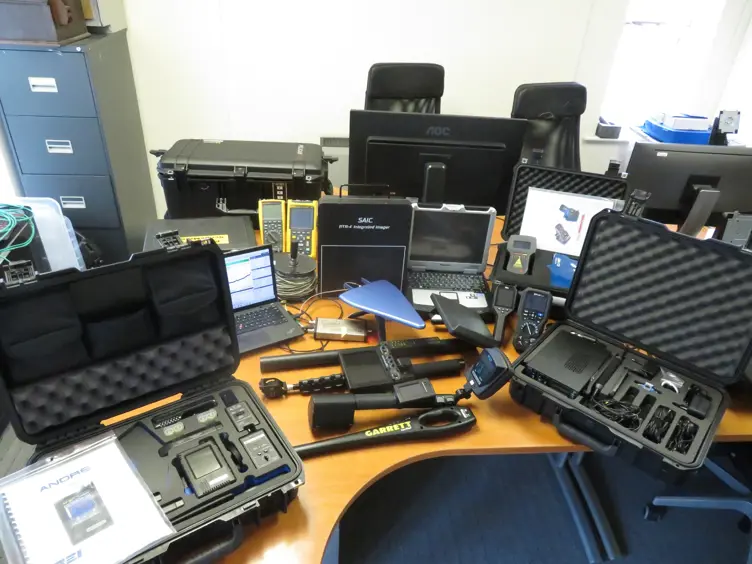
Physical inspection and electronic examination answer different questions. The survey scope should identify which methods are appropriate for the rooms, equipment and surveillance concerns involved. Confirm the instruments, access and specialist arrangements needed before the visit.
The methods and equipment are selected for the agreed scope and site conditions.
Method and equipment | Purpose within the agreed survey |
|---|---|
RF spectrum analysis and receivers | Examine radio-frequency activity and investigate signals that need explanation. Observations must be assessed against legitimate equipment and the survey environment. |
Non-linear junction detection (NLJD) | Look for electronic components, including devices that are not transmitting or are switched off. A response requires investigation; it does not by itself establish a surveillance device. |
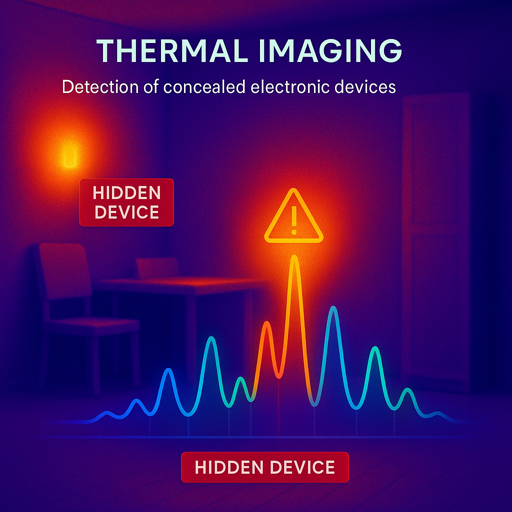
Thermal and visual inspection | Use visual examination and relevant heat-pattern observations to identify items needing closer inspection. Thermal observations alone do not establish covert surveillance. |
Wireless mapping and signal logging | Record relevant wireless activity and compare observations with the devices and services expected at the location. |
Pole cameras and borescopes | Examine accessible areas that are difficult to view directly, subject to permission and restrictions on moving or opening fixtures. |
Specialist object imaging | Discuss whether examination of a particular object needs additional imaging, such as X-ray inspection, and agree suitability and site arrangements separately. |
Understanding the result
The report should distinguish observations requiring investigation from confirmed findings. Agree the expected reporting format, any permitted photographs or signal records, and how urgent concerns will be escalated. Conclusions depend on access, methods and conditions at the time of the survey.
The number and complexity of spaces, access arrangements and agreed technical coverage affect the work and schedule. Discuss these before booking. No survey can guarantee that every vector is detected or that a space remains unchanged afterwards.
Our Proven TSCM Process
At ProCheckUp, we approach TSCM with military-grade rigour, adapted to your environment—whether boardroom, government site, executive residence, or SCIF.
Our five-phase methodology ensures that no vector of compromise is missed.
1. Initial Consultation & Threat Discovery:-
Stakeholder interviews
Site layout and functional mapping
Prior incidents or risk triggers identified
Confidentiality protocols initiated
Objective: Tailor the sweep to real-world threat probability, not generic checklists.
2. Physical + Electronic Inspection:-
Floor-to-ceiling visual sweep of all spaces and furniture
In-depth cavity checks, ceiling tiles, sockets, light fixtures
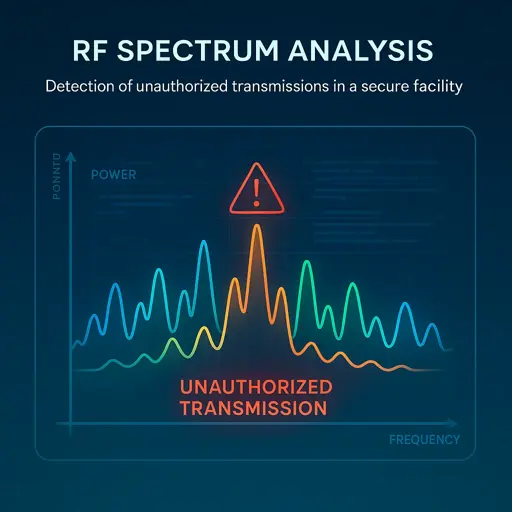
RF spectrum sweeps (0–6 GHz) including hidden carrier modulations
Detection of inactive components via NLJD and thermal readings.
Every device tells a story. We listen even when it's silent.
3. Communications Security (COMSEC) + ITSEC Integration:-
Detection of rogue Wi-Fi / BLE / ZigBee / LTE emissions
Portable network mapping and signal triangulation
Analysis of endpoints, voice systems, and cloud mirroring risks
Optionally includes XDR (Extended Detection Response) review for advanced clients
No modern TSCM sweep is complete without wireless and IT integration.
4. Detection Equipment Used:-
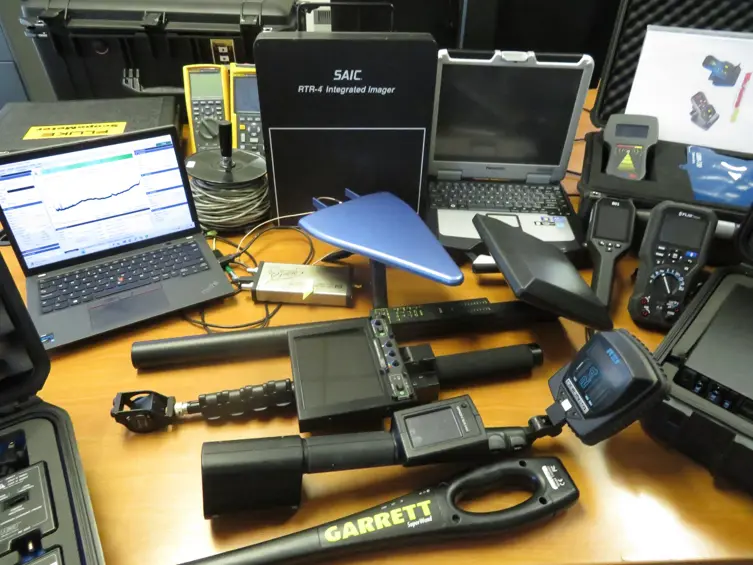
Our engineers deploy the following real-world field equipment:-
Category | Sample Tools Used |
|---|---|
RF Detection | REI OSCOR 5000E, SignalSDR PRO, Signal Hound SA124B |
NLJD (Non-Linear Junction Detection) | REI ORION 2.4 HX NLJD, Lux NLJD |
Thermal/Visual Tools | FLIR E60, Carson NV-200 NV Scope, Walabot DIY2, Spyfinder Pro |
X-Ray Systems | Golden Engineering XR-150, SAIC RTR4-L Imager |
Wireless Mapping | REI Andre, REI CPM 700, NetAlly AirCheck G3 Pro, WolfHound Pro |
Hard-to-Reach Areas | REI PSK, REI VPC-64 Pole Camera, Borescopes, , Jonard WiSpy |
Signal Logging | Thinpad X13 Gen2 + Signal Hound SA124B |
All devices are calibrated per operation and reviewed post-sweep for evidence integrity.
5. Analysis, Reporting & Aftercare:-
Executive Summary + High-Risk Findings
Risk Maps with annotated signal / device data
Photo documentation (where permitted)
Remediation Roadmap
Optional: Return sweep, installation of RF monitoring sensors
Sector Use Cases – Who We Protect
TSCM is no longer reserved for diplomatic envoys and Fortune 100 boardrooms. Today, threat actors target any vulnerable conversation with long-term value. We serve:
1. Government & Public Sector
Government offices
Regulatory enforcement bodies
Civil service investigation teams
Sensitive project zones (e.g., urban planning, defence policy)
Use Case: Prevention of internal meeting leakage prior to policy announcements.
2. Legal & Financial Firms
M&A law firms
Arbitration chambers
Wealth management & investor due diligence
Sensitive project zones (e.g., urban planning, defense policy)
Use Case: Elimination of device-level listening risks during contentious acquisition negotiations.
3. Healthcare & Life Sciences
Biosecurity labs
Pharmaceutical R&D
NHS Data Privacy teams
Use Case: Mitigating espionage risk during clinical trial cycles and AI-model training sessions.
4. Critical Infrastructure & Utilities
Energy regulators
Water quality auditors
Telecom infrastructure facilities
Use Case: Pre-sweep before stakeholder audits, after insider termination events, or during union negotiations..
5. Private Residences & Executive Rooms
Executive board retreats
Political consultants
Ultra-high-net-worth private rooms
Use Case: Peace of mind and protection of familial, financial, or transition-related discussions
Download our sample presentation.
Related services
Incident response and digital forensics when suspected compromise requires examination of internal digital evidence.
OSINT assessment for a separate question about publicly available exposure.
Security assessment services for wider technical control and exposure questions.
Discuss a confidential TSCM survey
Discuss a confidential TSCM survey. Tell us how to contact you and the type of location to assess. Agree sensitive-information handling and survey boundaries with the team.
When the concern also involves access to premises
If your concern includes doors, visitor controls, staff challenge or access to restricted areas, review our physical security audit service alongside the TSCM scope. The town hall physical-security case study illustrates that separate type of assessment; it is not evidence of a surveillance detection survey.
Need Help?

If you have any questions about cyber security or would like a free consultation, don't hesitate to give us a call!
For More Information Please Contact Us
ACCREDITATIONS