Case Study: IoT Penetration Testing
One exposed service can become control of an entire device when applications, wireless components, update processes and administrative services all share the same root-level trust boundary.
This case study outlines a ProCheckUp security assessment of a commercial e-paper tablet intended for use within a corporate environment. The engagement examined the device’s exposed interfaces, authentication model, storage controls, embedded Linux software stack, wireless implementation and enterprise-integration capabilities.
Overview
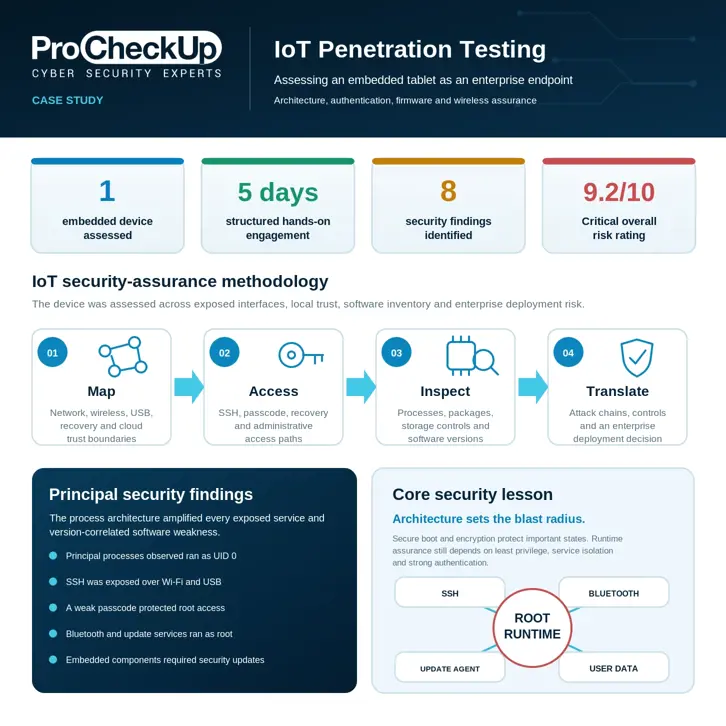
A large international organisation commissioned ProCheckUp to perform a comprehensive IoT penetration test of a commercial e-paper tablet. The objective was to determine whether the device’s build configuration, installed software, network security and privilege model were suitable for enterprise use.
The authorised, non-destructive engagement followed a structured five-day methodology combining network enumeration, authentication testing, filesystem inspection, data-protection review, wireless assessment and enterprise-integration analysis.
The assessment identified eight security issues: two Critical, three High and three Medium. The overall device risk was assessed as Critical, 9.2 out of 10, driven primarily by the absence of meaningful privilege separation and by an embedded software stack requiring security updates.
Engagement at a glance
- - One commercial e-paper tablet assessed as a complete enterprise endpoint
- - Five-day hands-on IoT and embedded Linux security review
- - Network, wireless, USB, local storage, cloud-sync and recovery pathways considered
- - Authentication, process ownership, package inventory and enterprise controls examined
- - Eight final findings and a prioritised remediation roadmap
- - Destructive hardware analysis and long-term behavioural monitoring excluded
Challenge
Embedded-device assurance requires more than a remote vulnerability scan. The most important weaknesses can exist beneath the visible user interface in service ownership, firmware patch state, local authentication and the relationships between network-facing processes and sensitive data.
Closed-device inspection without destructive teardown
The assessment needed deep visibility into services, packages, storage and runtime privileges while excluding eMMC removal, side-channel testing and other destructive hardware techniques. ProCheckUp therefore combined network access, authorised SSH and direct filesystem inspection to establish the device’s trust model.
Authentication testing without disrupting the device
SSH was exposed across common device interfaces and protected by a weak six-digit local passcode. Testing had to validate the practical access risk without causing lockout, filesystem corruption or avoidable disruption before evidence had been captured.
Consumer architecture in an enterprise setting
The tablet combined embedded Linux, cloud synchronisation and consumer wireless technology with expectations for MDM, VPN, certificate-backed access and directory integration. Enterprise suitability therefore depended on the whole operating model, not simply on the presence of encryption or secure boot.
Requirements
The IoT penetration test followed a five-day technical and operational plan:
- Day 1 — Critical vulnerability discovery: enumerate network services, evaluate SSH root access, assess passcode security and review recovery-mode pathways.
- Day 2 — Data security and storage: verify encryption, inspect filesystem structures, assess SSH-based extraction and review cloud-sync data flows.
- Day 3 — Network and wireless security: review Wi-Fi protocols, enterprise authentication compatibility, man-in-the-middle exposure, Bluetooth and SSH reachability.
- Day 4 — Enterprise integration: assess the device’s compatibility with MDM, VPN, certificates, directory services and RADIUS-backed controls.
- Day 5 — Risk and remediation: consolidate evidence into a risk matrix and immediate, medium-term and strategic remediation roadmap.
Explicit exclusions included destructive hardware analysis, side-channel or electromagnetic work, extended IoT compliance frameworks, custom exploit development beyond proportionate proof-of-concept activity and long-term behavioural monitoring.
Solution
ProCheckUp combined active network testing, controlled authentication validation, SSH and filesystem inspection, process-owner analysis and correlation of the installed package inventory against the vulnerability references supplied for the engagement.
The assessment followed four stages:
- 1. Map: identify network, wireless, USB, recovery, cloud-sync and local-data trust boundaries.
- 2. Access: validate exposed services, authentication strength and available administrative pathways without destructive action.
- 3. Inspect: review process ownership, filesystem protections, installed packages, SUID binaries and software versions.
- 4. Translate: correlate the evidence to plausible attack chains, compensating controls and enterprise deployment decisions.
Manual evidence was prioritised over version strings alone. Confirmed architecture and configuration weaknesses were separated from software findings inferred through package-version correlation. For example, the vulnerable rsync binary was present, but no externally listening rsync daemon was observed during testing; this reduced immediate exploitability without removing the need to patch or remove the component.
Vulnerabilities Identified
The severity distribution was two Critical, three High and three Medium findings. The flat root execution model amplified the impact of every exposed service and vulnerable component.
Complete absence of privilege separation — Critical, CVSS 9.1
The principal processes observed on the device — including the user interface, Wi-Fi supplicant, SSH service and update agent — operated as UID 0. A successful compromise of any one of these processes could therefore provide unrestricted root access without a separate privilege-escalation stage.
Recommendation: introduce service-specific identities, Linux capabilities, sandboxing and restricted update privileges. Because this requires architectural change, customer-side controls should focus on isolation, service reduction and strong authentication until vendor remediation is available.
SSH exposure and weak local authentication — High, CVSS 8.2
Dropbear SSH was reachable over Wi-Fi and USB interfaces and was protected by a six-digit numeric passcode without effective rate limiting. The assessed software inventory also contained an older Dropbear release, materially reducing the effort required to target the root-access boundary.
Recommendation: disable SSH where it is not operationally required, restrict access to a dedicated management path, enforce substantially stronger credentials and apply current vendor updates.
rsync 3.2.7 vulnerability suite — Critical, CVSS 9.8
The installed binary was correlated with six supplied CVE references describing a potential chain from heap overflow through address-space bypass to remote code execution. No rsync daemon was observed listening on an external interface during the assessment, so immediate remote exploitability was lower than the headline package score alone might suggest.
Recommendation: update or remove the vulnerable binary and ensure future firmware or configuration changes cannot expose the service unintentionally.
glibc vulnerability exposure — High, CVSS 7.8
The assessed package inventory included the supplied glibc vulnerability references, while ten identified SUID binaries created a relevant local escalation context. The all-root runtime reduced the practical distinction between process compromise and complete device control, but the vulnerable components still required remediation.
References recorded in the source assessment: CVE-2025-4802 and CVE-2025-8058.
BlueZ 5.72 nearby code-execution risk — High, CVSS 6.5–7.1
The installed Bluetooth stack was correlated with a stack-based overflow affecting the AVRCP profile. The potential impact was amplified because the Bluetooth daemon was observed operating with root privileges.
Reference recorded in the source assessment: CVE-2023-44431.
Vim path-traversal exposure — Medium, CVSS 6.5
The installed Vim 9.1 package was associated with supplied path-traversal weaknesses that could support local file access or manipulation under suitable conditions.
libarchive denial-of-service exposure — Medium, CVSS 6.5–7.8
The installed archive library was correlated with supplied integer-overflow and double-free conditions affecting archive parsing.
References recorded in the source assessment: CVE-2025-5914 and CVE-2025-5918.
util-linux local escalation weakness — Medium
The installed utility suite included the supplied wall escape-sequence vulnerability reference, creating an additional local privilege concern. The source summary did not state a CVSS score for this finding.
Reference recorded in the source assessment: CVE-2024-28085.
How the Findings Should Be Read
Confirmed on the assessed device
- - Principal process ownership and the UID 0 execution model
- - SSH exposure across Wi-Fi and USB interfaces
- - The local numeric passcode model and absence of effective rate limiting
- - Installed package versions and identified SUID binaries
- - Positive controls including secure boot and full-disk encryption
- - No externally listening rsync daemon observed during the test
Authorised Attack-Path Model
The following risk model explains why one reachable service could collapse the device boundary:
- 1. Discover the device: an attacker on a trusted or adjacent network identifies the tablet and exposed interfaces.
- 2. Profile SSH or Bluetooth: Dropbear, BlueZ and other embedded components reveal accessible attack surfaces.
- 3. Obtain initial execution: weak authentication, a vulnerable service or a local flaw provides an entry point.
- 4. Inherit UID 0: the compromised process already operates as root, so no separate privilege escalation is required.
- 5. Access live data: unlocked content, configuration, credentials and synchronisation artefacts become reachable.
- 6. Extend organisational impact: stolen information or credentials could support cloud abuse, sensitive disclosure or network pivoting.
Control Effectiveness
Controls that reduced risk
- - Secure boot increased resistance to unauthorised firmware replacement
- - Full-disk encryption improved protection for a powered-off or stolen device
- - No active rsync daemon was observed listening externally during the assessment
- - Non-destructive testing preserved the device and customer data
Why the overall rating remained Critical
- - Every principal process observed operated with root privileges
- - SSH was reachable across common device interfaces
- - The local passcode model was too weak for a root-access boundary
- - Multiple embedded components lagged relevant security updates
Secure boot and encryption were meaningful protections, but they did not provide runtime containment once an exposed root process or active session had been compromised.
Outcome
The engagement gave the customer an evidence-based view of the tablet’s security posture and of the limits of configuration-only remediation. The device was assessed as carrying a Critical overall risk for sensitive enterprise use because the all-root process architecture made any successful service compromise disproportionately damaging.
The customer was advised to treat the device as untrusted for sensitive workflows, apply available software updates, strengthen local authentication, restrict or disable SSH, remove unnecessary services and place the device on a dedicated, tightly controlled network segment.
ProCheckUp also made the remediation ceiling explicit. Network segmentation, service minimisation and stronger credentials could materially reduce exposure, but full remediation of the privilege-separation weakness required vendor-level architectural redesign.
Remediation Priorities
Immediate containment
- - Treat the device as untrusted for sensitive or privileged workflows
- - Apply available updates for rsync, glibc, BlueZ, Vim, libarchive and util-linux
- - Disable or tightly restrict SSH and remove unnecessary network services
- - Replace weak numeric authentication with the strongest supported local credential
- - Isolate the device on a dedicated VLAN with restrictive firewall policy
Medium-term defensive integration
- - Use network access control and certificate-backed enterprise Wi-Fi where supported
- - Restrict cloud-sync destinations and apply data-classification rules
- - Introduce service allow-listing, device monitoring and controlled management paths
- - Reassess MDM, VPN, certificate and directory integration against the intended deployment model
- - Retest after firmware, package and configuration changes
Strategic architectural requirements
- - Require vendor separation of services into least-privileged accounts
- - Introduce sandboxing, Linux capabilities and restricted update processes
- - Define IoT procurement criteria for patch cadence and enterprise-control support
- - Reassess suitability before broader deployment to sensitive users
The Core Security Lesson
Architecture sets the blast radius.
Secure boot, encryption and patching matter, but enterprise assurance also depends on service isolation, least privilege, strong authentication and the ability to contain one compromised component before it becomes control of the whole device.
The correct question is not simply:
“Does the device encrypt its storage?”
It is:
“What remains protected after one network-facing process is compromised?”
How ProCheckUp Helps
ProCheckUp’s IoT penetration testing services assess connected devices as complete security systems rather than isolated network endpoints. Support can include:
- - External and local attack-surface mapping
- - Firmware, package and embedded operating-system analysis
- - Authentication, privilege and service-isolation testing
- - Wi-Fi, Bluetooth, cellular and nearby-radio assessment
- - USB, serial, recovery and administrative-interface review
- - Secure-boot, storage-encryption and data-extraction testing
- - Cloud, mobile-application and API dependency assessment
- - MDM, VPN, certificate and enterprise-integration review
- - Hardware-assisted analysis where expressly authorised
- - Prioritised remediation and verification testing
Related services include IoT penetration testing, wireless testing and device security reviews.
Conclusion
This engagement demonstrated why connected-device security cannot be reduced to a list of CVEs. The decisive issue was the relationship between exposed interfaces, weak authentication and a runtime architecture in which every principal process shared root privilege.
By combining software updates with service minimisation, network isolation, stronger authentication, enterprise access controls and explicit vendor requirements for least privilege, organisations can substantially reduce the risk created by embedded devices before they become established within sensitive business workflows.
To discuss an IoT penetration test, embedded-device review or enterprise deployment assessment, contact ProCheckUp.
Discuss a similar assessment
See our iot security testing services or contact ProCheckUp to discuss your scope.
Need Help?

If you have any questions about cyber security or would like a free consultation, don't hesitate to give us a call!
For More Information Please Contact Us
ACCREDITATIONS