Healthcare cybersecurity: protect care, information and continuity
Healthcare cybersecurity should support safe patient care, reliable clinical information and continuity of essential workflows. An incident can affect appointment booking, diagnostics, prescribing, treatment or the ability to share results—not just the confidentiality of a database.
Begin with the clinical service and the consequences of losing availability or trust in its information. Involve clinical, operational, IT, information-governance and medical-device owners in decisions about testing and change.

Reviewed: 26 October 2026.
Map the care pathway and its dependencies
| Workflow | What could fail | Questions to answer |
|---|---|---|
| Patient access and scheduling | Bookings, referrals or identity matching become unavailable or incorrect. | What is the safe fallback, and how are records reconciled afterwards? |
| Diagnostics and results | Laboratory, imaging or interfaces are disrupted or data integrity is uncertain. | Who validates results and prioritises urgent work? |
| Clinical records and prescribing | Staff cannot access current information or trust its accuracy. | Which downtime procedures are approved and how are changes reconciled? |
| Connected devices | Management, monitoring or communications are affected. | Who owns the device, support relationship and safe operating limits? |
| Supplier-supported services | A partner outage or compromised remote access affects care. | What are the dependencies, response contacts and alternatives? |
Document business and clinical owners, recovery order and the information required for safe operation. A technical recovery target should be agreed with the people delivering care.
Prioritise controls around the care risks
| Priority | Practical action | Evidence |
|---|---|---|
| Access | Limit privileges, protect remote/administrative access and use workable authentication. | Access reviews, leaver checks and tested emergency access. |
| Exposure and updates | Identify supported versions and exposed services; coordinate changes safely. | Asset/support records, verified updates and owned exceptions. |
| Segmentation | Restrict unnecessary paths between clinical, device, administrative and guest environments. | Architecture and safe validation of intended boundaries. |
| Information integrity | Protect records and interfaces against unauthorised change. | Audit trails, access tests and reconciliation procedures. |
| Detection and response | Make suspicious activity reportable and actionable. | Current contacts, alert ownership and rehearsed escalation. |
| Recovery | Protect copies and restore the whole clinical workflow. | Observed recovery, integrity checks and unresolved dependencies. |
Manage connected devices through their whole lifecycle
| Stage | Questions for the clinical, engineering and IT owners |
|---|---|
| Procurement | What software and connectivity are required? Who provides updates and vulnerability information? What are the support period, access needs and arrangements for eventual replacement? |
| Deployment | Where is the device used, which service depends on it and which systems can it reach? Are default credentials, remote support and network settings configured appropriately? |
| Operation | Who owns inventory, software/support status, configuration and relevant logs? Are supplier access and changes approved and recorded? |
| Change or patch | What manufacturer guidance, compatibility checks, clinical approval and maintenance arrangements are needed? Is there a safe rollback or alternative service? |
| Retirement | How are patient information, credentials and network/supplier access removed? Is disposal confirmed and the asset record updated? |
An unsupported or difficult-to-update device needs an explicit risk and service decision. Consider restrictions on connectivity, access and removable media, monitoring and a funded replacement plan with the relevant owners. Do not assume those measures make an unsupported product equivalent to a supported one or meet every applicable obligation.
Use the device inventory to identify groups with shared operating systems, management methods and clinical dependencies. Include diagnostic equipment, supporting workstations and gateways, as well as less visible building or facilities systems where they affect service delivery. Any active discovery or test must follow the agreed clinical and operational safety process.
Do not apply an office-computer hardening script indiscriminately to medical equipment. A change that appears to improve one security setting may affect compatibility or essential functionality. Security, clinical engineering and care-service owners need a shared view of the consequence and acceptance criteria.
Understand DSPT and other obligations in context
The Data Security and Protection Toolkit is used by organisations accessing NHS patient data and systems. Requirements depend on organisation type, services, contractual arrangements and the relevant assessment year. Private providers and suppliers should determine their actual obligations rather than assume every healthcare organisation has identical requirements. DSPT official site.
For 2026–27, the published organisation-type guidance defines four categories; Category 1 uses a CAF-aligned view. This should not be described as a universal CAF requirement for every clinic, care provider or supplier. Confirm your category and evidence set using the current guidance. DSPT 2026–27 organisation types.
Applicable UK data-protection duties also require attention to lawful use, security, rights and breach decisions. A completed toolkit does not by itself demonstrate that every clinical system is safe or every legal obligation has been met.
Check NIS obligations separately. Establish whether the organisation is a designated operator of essential services under the applicable Network and Information Systems regime. In England, the Department of Health and Social Care’s health-sector guide explains designated operators’ duties to manage risks to the systems supporting essential healthcare services and to report qualifying significant incidents.
Record the applicable authority, reporting route, decision-maker and escalation process in the incident plan. DSPT assessment, personal-data breach reporting and NIS duties are related but distinct; one submission should not be assumed to satisfy every obligation. Organisations operating elsewhere in the UK should check the relevant national arrangements. These duties must not be presented as identical for every clinic, private provider or healthcare supplier.
Further guidance: DHSC: NIS Regulations guide for the health sector in England.
Protect patient information and usable clinical access
Accounts, emergency access and remote support
Review access by role and care context, including temporary staff, suppliers and administrators. Make authentication practical in the actual environment and give staff a controlled route to essential information during outages. Avoid a design that drives teams towards shared credentials or unofficial copies of records.
Define any emergency-access process with the appropriate clinical and information-governance owners. Record and review its use. Ensure that restricting a compromised account or supplier connection is an authorised, coordinated decision with awareness of the care dependency.
Data sharing, cloud services and records
Map records and interfaces between clinical systems, laboratories, imaging, referrals and suppliers. Establish who can view, modify, export and delete information. Include bulk exports, messaging and backups, not only the primary patient-record application. Protect relevant data in transit and storage, with controlled key access and recovery.
For a cloud or hosted service, confirm who configures permissions, reviews logs, maintains integrations and supplies usable data during recovery or exit. Shared responsibilities should name actions and owners. A secure hosting claim does not establish that a local integration or account configuration is correct.
Phishing, impersonation and information requests
Train staff on the tasks they encounter: an unexpected request for patient information, a supplier support call, an account reset or a finance instruction. Provide a trusted verification route that works under time pressure. Familiar names, clinical urgency or a convincing voice do not by themselves authorise disclosure or a system change.
Give teams a quick way to report mistaken disclosures and suspicious account activity. Investigate proportionately and support early reporting. Confirm applicability through the organisation’s information-governance arrangements and the NHS Data Security and Protection Toolkit where relevant; the practical controls are not a claim that every healthcare organisation has identical regulatory duties.
Test safely in a clinical environment
Agree clinical and technical authority before testing. Identify sensitive devices, protected systems, excluded actions, monitoring, maintenance windows, stop conditions and the person who can halt the work. An intrusive technique suitable for an ordinary test server may be unsuitable for equipment supporting care.
Start with architecture, documentation and configuration review where appropriate. Use representative laboratory or non-production environments for disruptive checks. Consult device manufacturers and clinical engineering about support conditions and safe methods. Even passive collection needs approval and careful handling of patient information.
| Assurance need | Proportionate method |
|---|---|
| Clinical application access boundaries | Authorised role-based testing using synthetic data. |
| Device or network configuration | Read-only evidence review and carefully agreed validation. |
| Exposure and supplier access | Architecture review, access-path checks and supplier evidence. |
| Incident readiness | A tabletop exercise involving clinical decisions and technical response. |
Record what could not safely be tested. An explicit limitation is more useful than implying complete coverage of fragile or unavailable systems.
Check the service behind the supplier assurance

Understand the actual service, data flows, remote access, subcontractors and recovery dependencies. Check incident cooperation, notification, log access, support hours and exit arrangements against clinical needs.
If a diagnostic provider becomes unavailable, can urgent work be redirected safely, results reconciled and patients informed? A contract or certificate should be supported by practical evidence and a tested coordination route.
Rehearse safe downtime and recovery
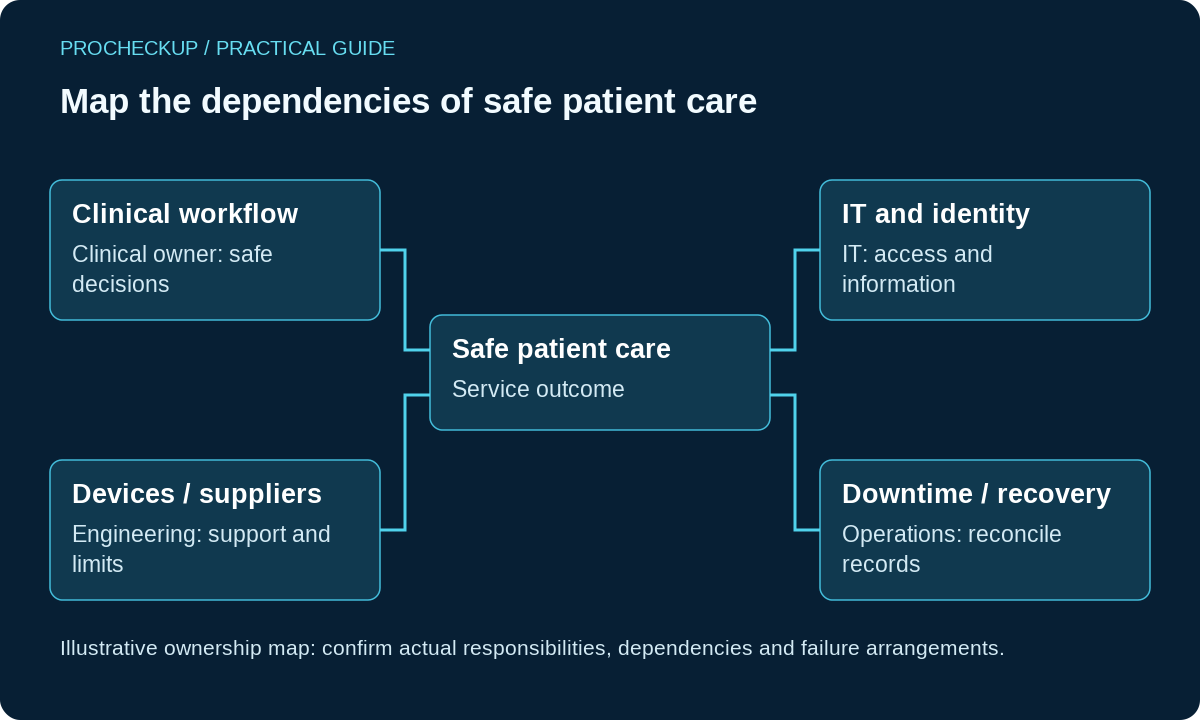
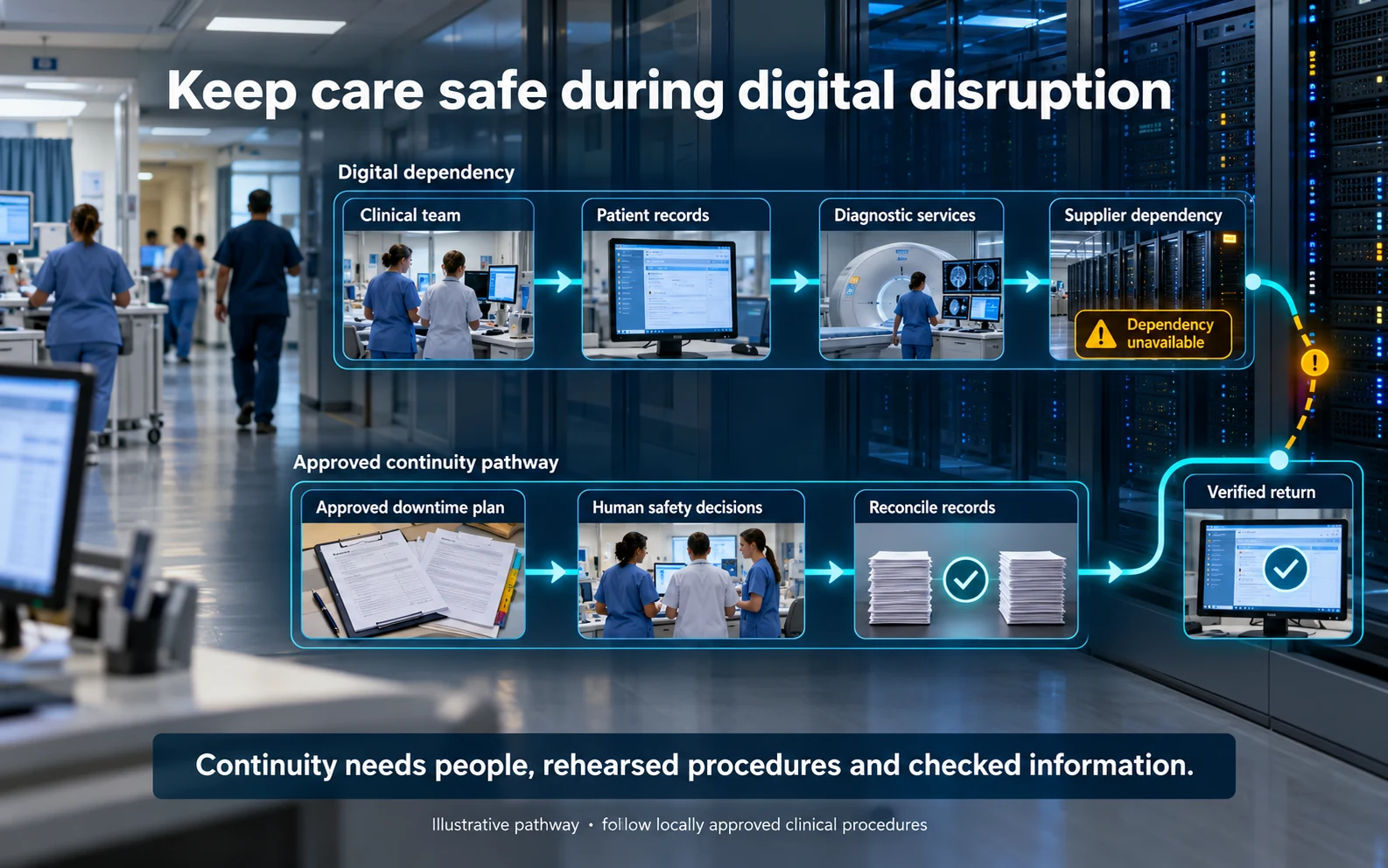
Exercise an illustrative loss of a diagnostic or records service. Include patient prioritisation, manual or alternative workflows, communications, access to essential information and recovery sequencing. Define who decides whether the service is safe to resume.
On restoration, reconcile changes made during downtime, confirm information integrity and verify interfaces. Track the impact on care and lessons about staffing, suppliers and authority alongside technical recovery times.
Turn the downtime plan into a safe, rehearsed workflow
A clinical service can be unsafe when information is wrong or incomplete, even if a computer remains online. Exercises should therefore consider loss of integrity and visibility as well as total outage. Clinical leaders determine the safe service arrangements; IT restoration alone cannot make that decision.
- Choose an important care pathway and identify the records, equipment, interfaces, staff and suppliers it requires. Define the impact of unavailable, delayed or unreliable information.
- Rehearse how the organisation activates its approved downtime process, communicates responsibilities and reaches essential contacts without relying on the affected service.
- Check how necessary information is recorded and protected during the interruption. Agree how duplicate entries, identity matching, outstanding results and delayed actions will be managed.
- Restore systems through the coordinated incident/recovery process, then validate interfaces and data consistency with the service owner.
- Reconcile records created during downtime and authorise the return to normal workflow. Record unresolved clinical and technical issues and assign follow-up actions.
For example, restoring a diagnostic application does not by itself confirm that all results reached the correct patient record. A useful exercise tests the handover between laboratory staff, interface owners and clinical teams. Keep test data and scenarios appropriate to the agreed environment.
Prepare communications for staff, partner providers, patients and other relevant parties through authorised channels. Align incident reporting with applicable duties, contracts and current guidance rather than assuming one universal notification threshold or deadline covers every event.
Common questions
Can medical devices be penetration tested like office computers?
Not automatically. Assess clinical risk, manufacturer guidance, support conditions and operational constraints. Use appropriate environments and explicitly agreed techniques.
Does every healthcare supplier use the same DSPT category?
No. Organisation type and applicable requirements matter. Check the current year’s official guidance and contractual obligations.
What should we do first with limited resources?
Choose a high-impact care workflow, identify its dependencies and owners, verify access and recovery, and close the most consequential gaps before expanding the programme.
Prepare for a healthcare assessment
Bring a service and asset map, device ownership, supplier responsibilities, existing findings and safe testing constraints. ProCheckUp can help define a proportionate scope with clinical and operational stakeholders. Related guidance: build reviews, penetration testing and ransomware readiness.
Need Help?

If you have any questions about cyber security or would like a free consultation, don't hesitate to give us a call!
For More Information Please Contact Us
ACCREDITATIONS