IoT Penetration Testing
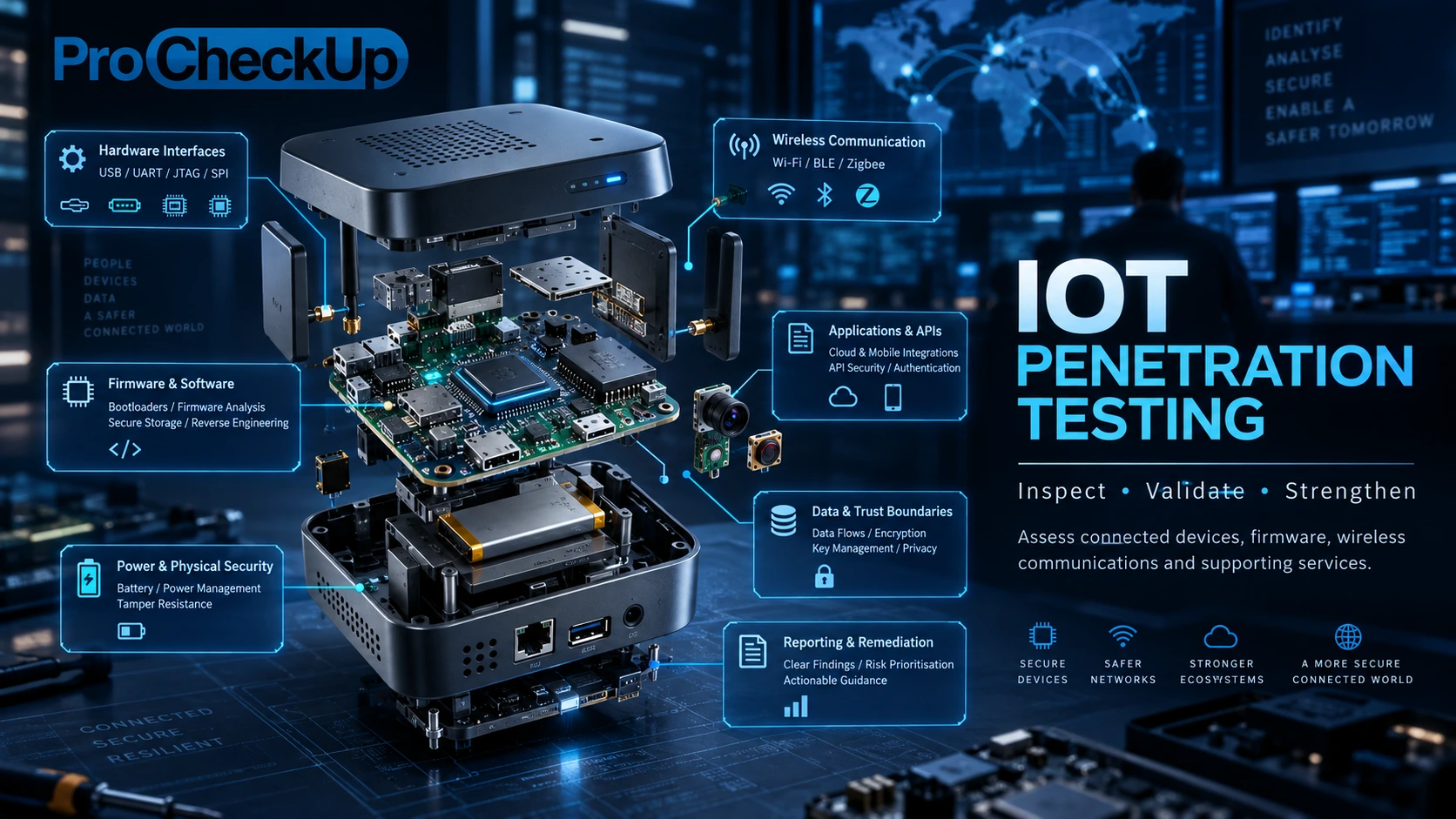
IoT penetration testing examines a connected device and the services around it. ProCheckUp assesses the hardware interfaces, firmware, wireless communication, applications and trust relationships that could expose the device or the information it handles.
Discuss an IoT device assessment with the product, deployment environment and security questions you need answered.
See the evidence and reporting approach
Our e-paper tablet security assessment examined a commercial device’s interfaces, embedded software, authentication, storage and enterprise controls. It shows the consequences of weak privilege separation and outdated components. The findings and scope relate to that particular engagement.
Download the sample IoT assessment report (PDF) to review the reporting format before discussing your device.
Scope the device ecosystem
Hardware and local interfaces: examine the agreed Ethernet, USB, serial, UART, JTAG, SPI and other interfaces. Identify which physical-access scenarios matter.
Firmware and software: review firmware acquisition, file systems, binaries, hardcoded secrets, authentication and update integrity.
Radio communication: agree coverage of cellular, Wi-Fi, Bluetooth Low Energy, Zigbee or Z-Wave according to the product.
Applications and APIs: define any companion mobile application, web interface, API or cloud service included in the test.
Data and trust boundaries: examine relevant storage, keys, permissions and interactions between the device and connected services.
Hardware, firmware and binary analysis
The assessment starts by mapping architecture and interfaces. Hardware work can include identifying diagnostic access and examining whether a local user can reach a shell or protected data. Reading or modifying hardware and firmware needs explicit agreement about damage, resets and recovery.
Firmware may be obtained from an authorised download, an update process or the device itself. Analysis can include extraction, file-system inspection, searches for hardcoded credentials, signature and integrity checks, and comparison of firmware releases. Binary disassembly, emulation and controlled validation help explain the impact of relevant weaknesses.

Wireless, application and cloud interfaces
Wireless checks examine the agreed communications and security boundaries. Companion software, web interfaces and APIs need their own authorised targets and accounts. Key management, data storage and network permissions are considered where they form part of the scoped product ecosystem.
A device test does not automatically authorise testing of a manufacturer’s shared cloud platform or a third party. Agree ownership, permissions and operational limits for each component.
Prepare devices and access
Identify the hardware model, firmware versions, product architecture and deployment scenario.
Agree representative devices, delivery or access arrangements, test accounts and any available documentation or firmware.
State whether opening a device, probing interfaces, resetting it or making potentially destructive changes is permitted.
Identify recovery arrangements, safety constraints, third-party dependencies and an escalation contact.
Agree coverage of supporting applications and cloud services, including exclusions.
Findings, remediation and verification
Findings should identify the affected component and version, the evidence and access required, the demonstrated impact and practical remediation. Distinguish device-local findings from issues in connected services, and record coverage limitations. A scoped assessment cannot prove a product is breach-proof.
Device complexity, interfaces, firmware accessibility and supporting services affect effort. Agree the scope and schedule for your product, then discuss verification of fixes and how hardware or firmware changes affect any retest.
Related assessments
Web application and API testing for supporting web services.
Mobile application testing for companion applications.
Cloud penetration testing for an authorised cloud environment.
Discuss an IoT device assessment
Discuss an IoT device assessment. Describe the device, versions, interfaces and the decision the assessment needs to support. Agree device handling and technical scope before sending equipment.
Need Help?

If you have any questions about cyber security or would like a free consultation, don't hesitate to give us a call!
For More Information Please Contact Us
ACCREDITATIONS