
AIpocalypse: AI Offensive Frameworks and the Patch-to-Exploit Race
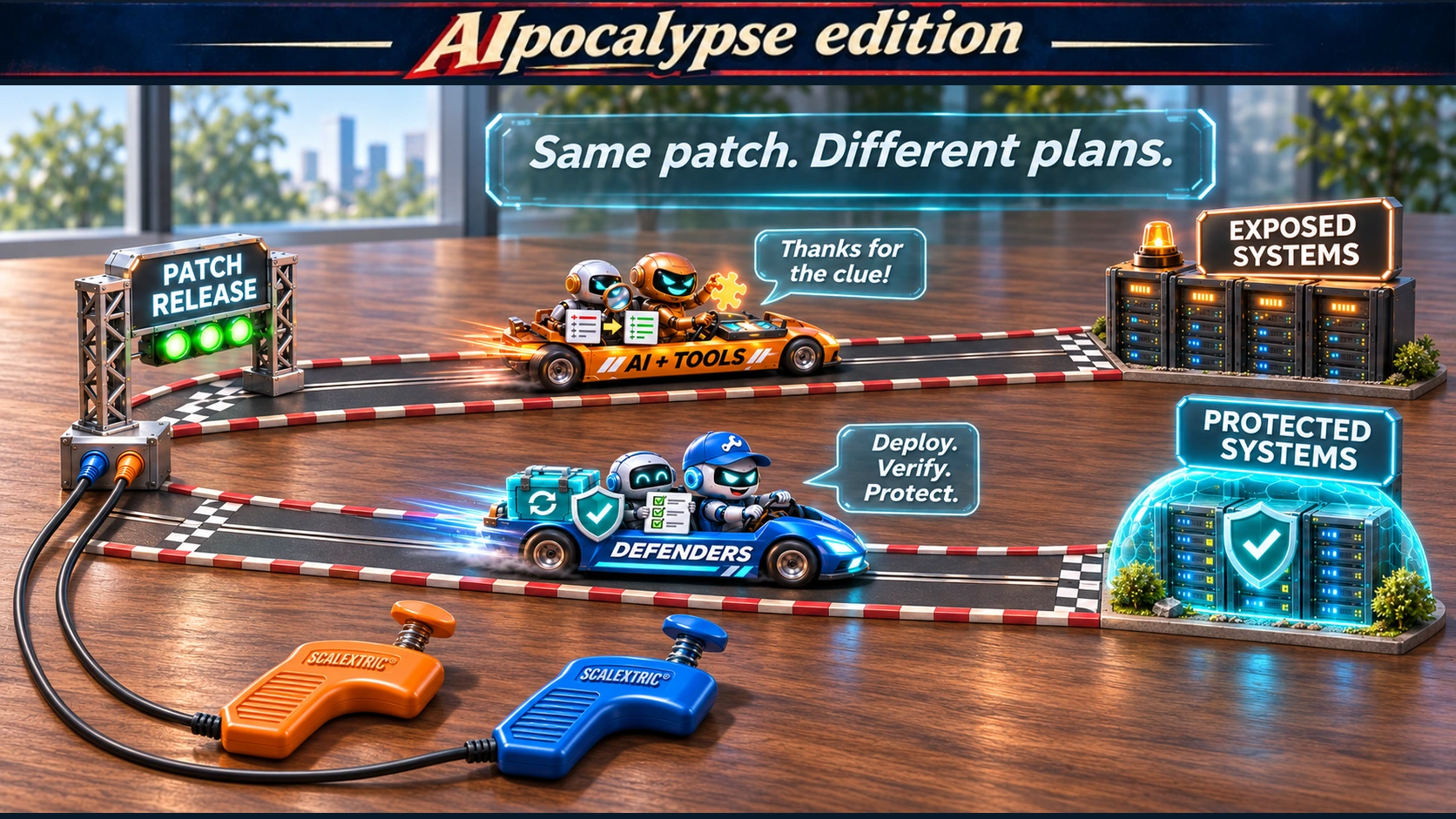
AI offensive frameworks connect language models to scanners, browsers, code analysis and command execution. They can turn a broad objective into many smaller tasks, inspect the results and try again. The immediate risk is a faster, cheaper way to exploit weaknesses that organisations have not yet fixed—not a guarantee that an AI can break into any system.
Research reviewed: 19 November 2026. This guide follows our earlier review of AI cyber attacks. It distinguishes project features, controlled demonstrations, reported malicious use and confirmed impact. “AIpocalypse” is our editorial shorthand for the pressure these developments place on security teams; it is not a formal threat category or a prediction of inevitable collapse.
What is driving the AIpocalypse?
First, separate the flaw from the exploit
A vulnerability is a weakness in software or its deployment. An exploit is a way of taking advantage of that weakness. Weaponisation means making an attack method usable and sufficiently reliable for an operator’s objective, potentially combining it with other steps. A convincing explanation, a crash and a successful intrusion are different outcomes.
Previously unknown vulnerabilities
Zero-day research seeks a previously unknown flaw. Public knowledge and patch availability are separate facts: a disclosed vulnerability can remain unfixed. AI may help discover a defect; writing an exploit does not create the underlying defect. Research can lead to coordinated disclosure and repair. NIST terminology.
Known vulnerabilities in unpatched systems
After disclosure, or after a fix becomes available, vulnerable installations can remain exposed. Often called n-day exploitation, this can be attractive because the advisory, changed code and existing research narrow the search.
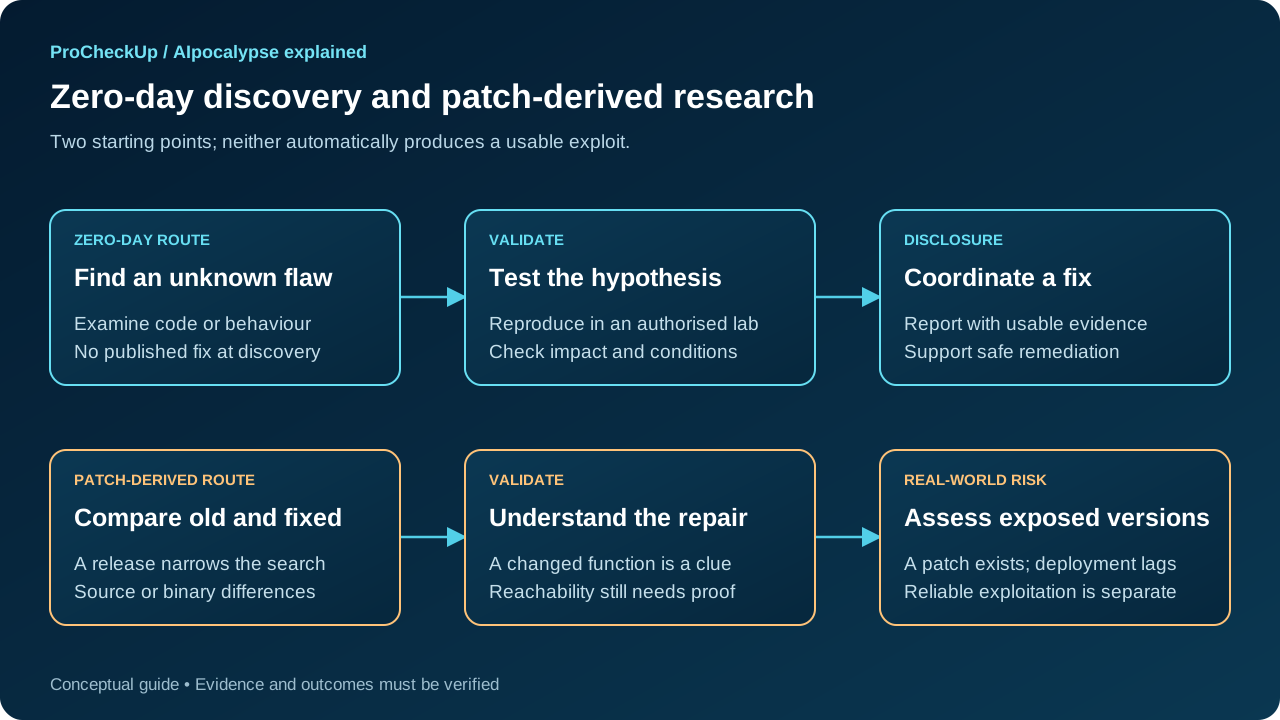
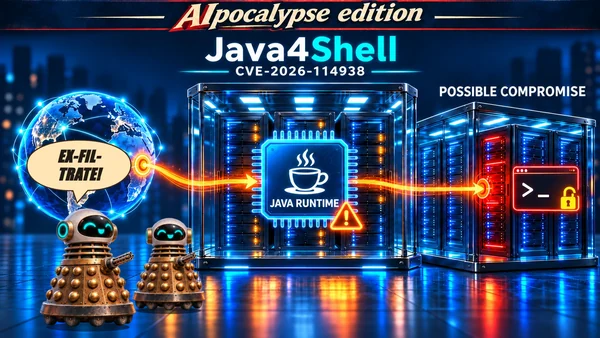
AI-assisted discovery has a defensive history. Google Project Zero’s Big Sleep work found a memory-safety flaw in SQLite development code, enabling repair before release. More recently, Calif’s Java4Shell account describes researchers and AI working together to find a flaw and develop application-specific exploit chains. Calif explicitly rejects the idea of one universal exploit. These examples demonstrate capability under described conditions, rather than a success rate for every model or target. Project Zero research · Calif’s Java4Shell research.
Five causes of the increasing pressure
- Better analysis of complicated software. Models can help explain unfamiliar code, propose hypotheses and interpret test results. A skilled reviewer still needs to distinguish genuine security behaviour from plausible but incorrect reasoning.
- Models connected to tools. An assistant that describes a scan is different from an agent able to launch one, read the output and choose another action. Its effective power depends on the credentials, network access and tools it receives.
- More work can happen in parallel. A coordinator can delegate separate questions to workers and reuse their findings. This reduces coordination effort without removing difficult prerequisites such as authentication, application-specific conditions or exploit reliability.
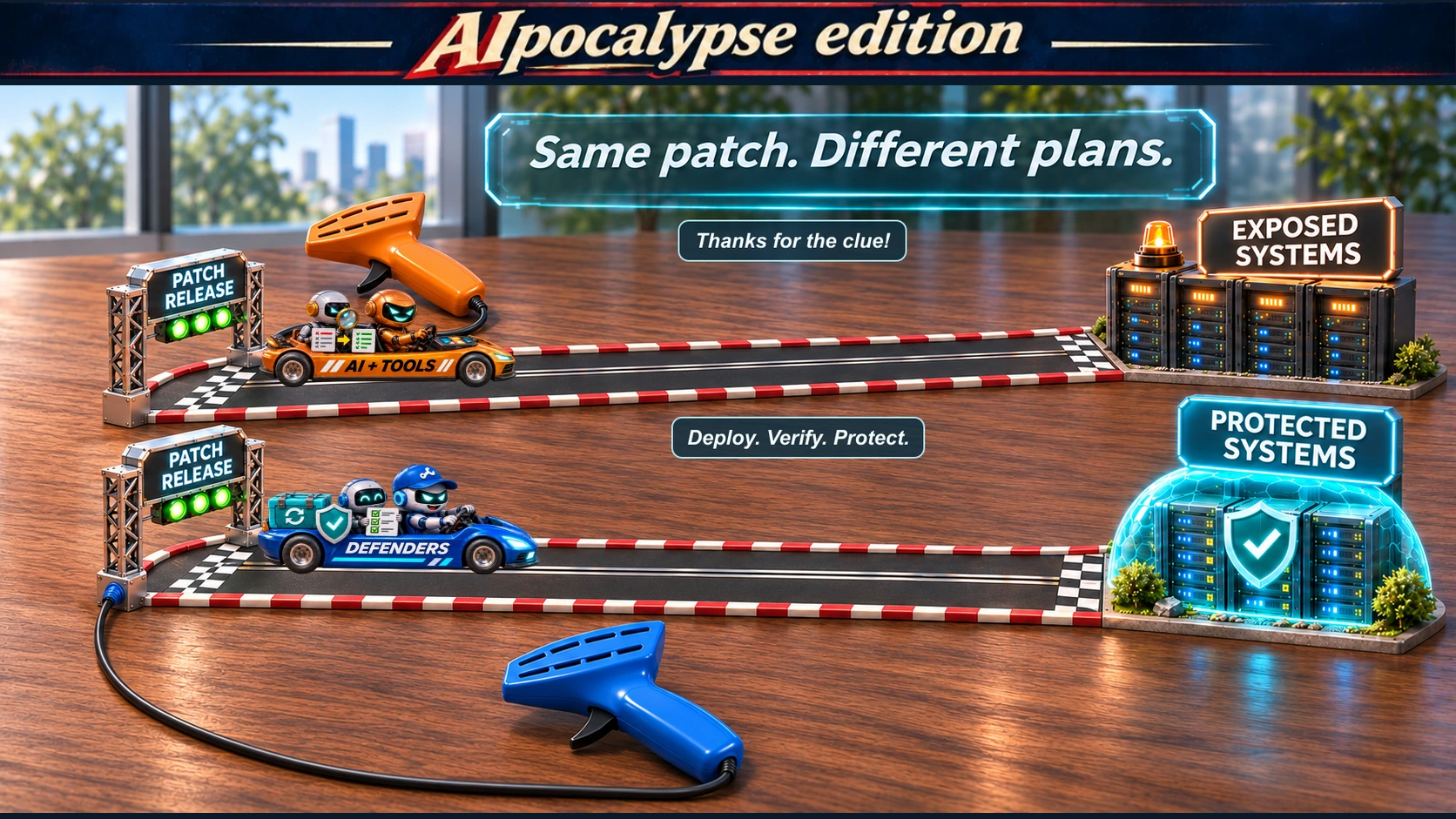
- Public fixes reduce uncertainty. Comparing releases can reveal where validation, memory handling or permissions changed. The defender’s rollout and the attacker’s investigation can therefore start from the same release.
- Organisations still change at human speed. Unknown assets, supplier dependencies, approvals and fragile legacy services slow remediation. More candidate findings and unreliable public proofs of concept also consume the people needed to verify real exposure.
Our assessment is that these factors reinforce one another: improved reasoning is more consequential when it can operate tools, and faster analysis is more useful to an attacker when vulnerable services remain reachable. The same capabilities can help defenders inventory systems, review changes and verify fixes—provided their access and decisions are controlled.
The NCSC’s 2026 assessment describes AI as an accelerator of existing attack methods, with uneven adoption and continuing human involvement. It also warns that vulnerability discovery and exploit development increase pressure on patch deployment. Its separate scenarios for 2028 explore possible futures; they should not be read as incident reports or guaranteed outcomes. NCSC Annual Review 2026 · NCSC scenarios and uncertainty.
The current offensive frameworks
Similar orchestration ideas, different evidence
A framework is not itself the language model: it connects a model to tools, workers and task state. Its behaviour depends on the selected model, permissions, configuration and operator. These projects generally coordinate existing security tools; a tool catalogue is not a catalogue of novel vulnerabilities. A Docker sandbox can separate local processes without verifying permission to test a remote system. Similarly, Model Context Protocol (MCP) provides a way to connect tools; it does not establish the target owner’s consent.
| Framework | What it coordinates | What the evidence supports |
|---|---|---|
| ARTEX | A planner and parallel specialist workers around offensive tools; Google describes a Go backend and web console. | Reported malicious use Microsoft and CrowdStrike describe separate campaigns. The framework name does not identify one actor or prove one common intrusion method. Google technical overview. |
| CAIRN | Workers share observations and proposed actions through a common board, using an observe–orient–decide–act loop. | Project documentation + reported use Google reports activity against US aerospace targets. The repository’s competition claims are not a measure of real-world success. |
| CyberStrikeAI | An operator platform, tool recipes, MCP integration and optional remote-control features. | Reported post-compromise use Kaspersky describes manual activity before implant deployment, followed by model-directed post-compromise actions. Current documentation also describes configurable approval controls; these must be assessed in the actual deployed version. |
| PentAGI | Multiple agents and security tools running in containerised environments, with shared context and task management. | Project documentation + reported use Google reports a customised deployment scanning Asian system integrators and telecommunications organisations. Scanning is not evidence that every target was compromised. |
| HexStrike AI | A tool-integration server exposing security-testing capabilities to AI clients. | Reported use / experimentation Google’s October report includes HexStrike in incident-response observations; its November update also discusses experimentation. Neither gives a per-framework success rate. Google’s October report. |
Google’s November update specifically describes independently observed CAIRN and PentAGI use and experimentation with CyberStrikeAI and HexStrike. That wording does not erase the earlier incident-response observations of HexStrike. Other investigators provide separate evidence about CyberStrikeAI. We therefore do not treat every framework as equally widespread, equally autonomous or equally well evidenced. GTIG November update.
The important change is the feedback loop
Rules-based automation can already branch, retry and react to results. An agent adds model-driven selection and revision of the next action, including interpreting less structured output and delegating another task. This can increase flexibility, but the model can also repeat mistakes, misread evidence or act outside scope. Fast activity alone does not distinguish an agent from ordinary automation.
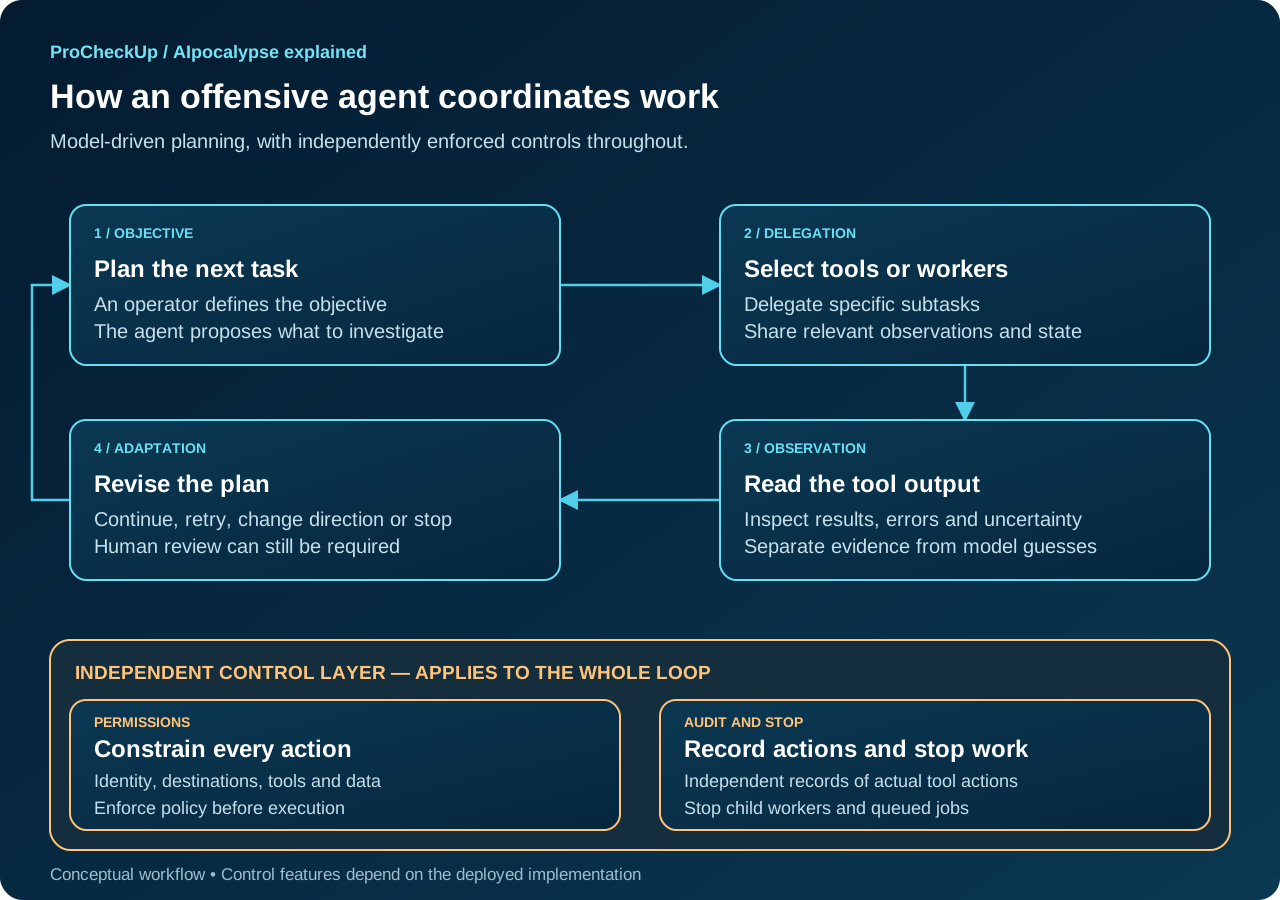
Elastic’s November source review found weak default authorisation in the versions of five frameworks it examined. This is a dated finding about reviewed code, not a permanent claim about every future release. For authorised testing, establish written scope and enforce it outside the model: allowed destinations, tool permissions, resource limits, approval gates and a way to stop all delegated work. A README disclaimer or an agent’s promise cannot perform those checks. Elastic’s framework review · CyberStrikeAI security documentation.
What the incident reports actually establish
ARTEX and different operators. Microsoft linked ARTEX to Storm-0940 activity involving compromised credentials and trust relationships; it describes some operations reaching privileged cloud access within three hours. Microsoft also says the majority of targeting was unsuccessful. The sub-three-hour cases are therefore specific outcomes, not a typical attack duration or a universal success rate. CrowdStrike separately analysed ARTEX-related activity targeting South Korean financial organisations without attributing it to the same named actor. Microsoft investigation · CrowdStrike investigation.
CyberStrikeAI after entry. Kaspersky’s education-sector investigation describes manual activity before the implant was deployed, followed by model-directed post-compromise actions. It does not completely reconstruct the initial access route. It demonstrates why defenders must watch what happens after a credential or foothold is obtained, while avoiding the stronger claim that AI independently completed the entire intrusion. Kaspersky investigation.
Fast automation does not prove AI decision-making. Elastic linked AWS activity across several accounts to a CyberStrikeAI server. Its CloudTrail analysis shows very fast request bursts, but the researchers explicitly could not prove an LLM made the decisions or establish how the credentials were first stolen. The attribution and its limits belong together. Elastic AWS investigation.
From a patch to a potential exploit
How a protective fix can reveal useful clues
A security update changes behaviour. A new check may reject an unsafe input; an ownership change may prevent memory being reused incorrectly; a permission check may close an unauthorised route. Comparing the earlier and repaired versions can help an analyst ask a narrower question: what was the new protection intended to prevent?
For source-available software, the comparison can examine readable code changes. For compiled software, binary analysis attempts to match functions and understand changed machine behaviour. Both require interpretation. A release can contain unrelated changes, compiler artefacts and several fixes; a conspicuous difference is not automatically the vulnerability.
Google reports finding exploit_agent on an exposed staging server: a workflow configured to compare patched web-application source, investigate differences, draft exploits and execute them. The example concerns web-application source comparison, not proof of BinDiff-driven binary weaponisation. The report does not publish a success rate for every generated exploit. GTIG’s reported observation.
A patch can also point to a new zero-day. An analyst may use a known repair as a lead to a related weakness that the repair did not address, or to the same pattern elsewhere. This is variant analysis. Project Zero’s Big Sleep work used recent SQLite changes to guide investigation of related code and found a separate flaw in development code. The known fix was the starting clue, not proof that the new finding was merely the already-fixed vulnerability. Big Sleep’s research method.
Conceptually, the path runs from a release signal, through comparison and a root-cause hypothesis, to controlled reproduction. Adapting a validated method for different configurations and integrating it into an operation is a further step. Each stage can fail. A crash may only establish availability impact; reliable code execution may require additional conditions and substantial expertise.
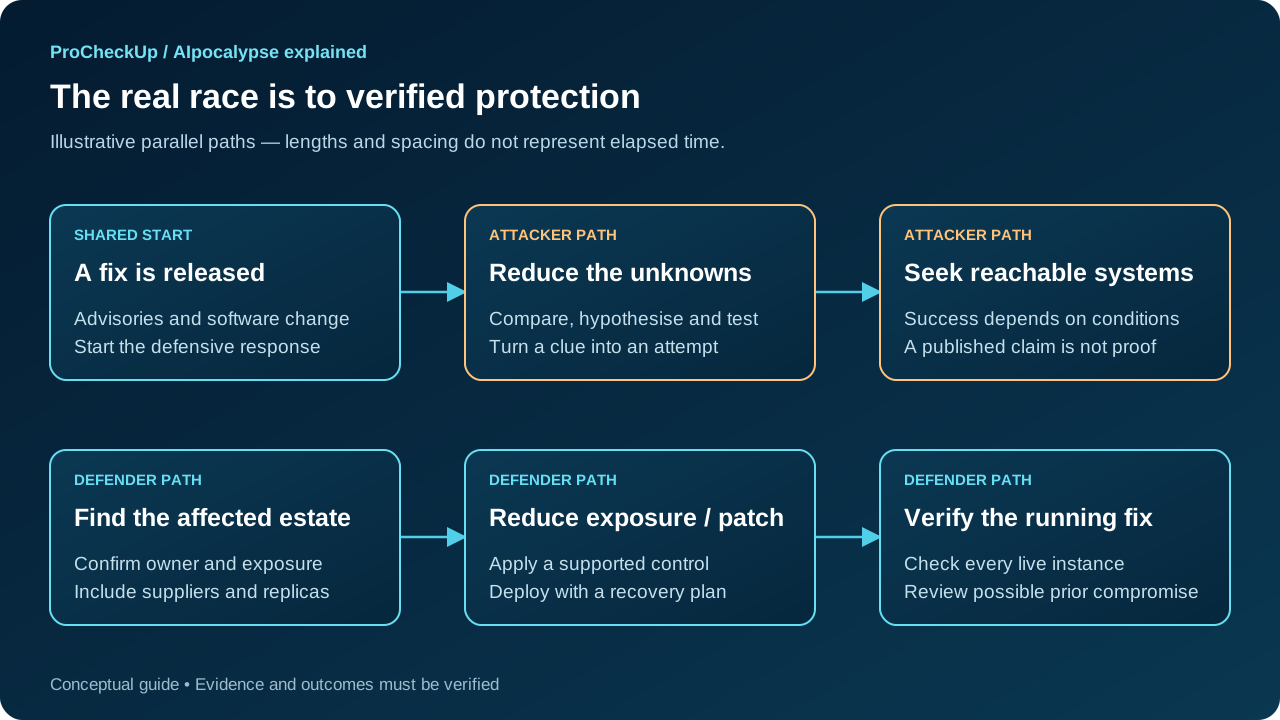
Do not respond by delaying fixes. A repair removes a weakness when deployed correctly. The practical response to patch-derived analysis is to reduce the gap between release, exposure assessment and verified protection—not to leave customers waiting for a fix.
Where BinDiff and AI-assisted patch analysis fit
BinDiff compares disassembled binaries and helps identify matched, changed and unmatched functions. Structural matching can make comparison useful even when code addresses move. Similarity scores are investigation aids, not security conclusions: a low score can reflect unrelated changes, while a high score can still conceal a meaningful operand difference. Analysts must inspect behaviour and the quality of the match. BinDiff manual.
Akamai’s PatchDiff-AI is a useful public example of combining that work with a language model. Its documented pipeline obtains Microsoft updates, compares binaries using IDA Pro and BinDiff, examines changed functions and produces a root-cause report. The project documents its software and licence prerequisites. An automatically generated analysis report still needs validation. Akamai also reports a human-guided case involving CVE-2025-32713 that reached a Windows crash demonstration in a few hours. An experienced researcher corrected misleading model output. That demonstrated availability impact; this case study did not demonstrate a complete privilege-escalation or remote-code-execution chain. Akamai’s research and evaluation · Project documentation.
Ghidriff provides another binary-diffing approach using Ghidra and generates reports. Those results can feed a separate analysis process; its upstream documentation should not be taken as proof of a native autonomous exploitation feature. Nor did this review establish that ARTEX, CAIRN, CyberStrikeAI or PentAGI natively performs BinDiff-style patch comparison. Tool orchestration and patch analysis can be combined, but they are distinct capabilities.
Keep disclosure, analysis and deployment times separate
The vendor disclosure window runs from a researcher’s report to public disclosure. Attacker analysis time is the work needed to turn available information into a useful attack. The customer’s exposure window ends only when protection is effective on the relevant systems. A shorter disclosure policy does not grant customers that long to patch, and a faster attack demonstration is not a universal deadline.
On 13 November 2026, Project Zero replaced its previous disclosure policy with “Full 90” and removed the extra 30-day post-patch period. It plans “Full 60” from 2 February 2027 and “Full 30” from 3 January 2028, subject to stated exceptions. Its rationale is that AI-assisted patch analysis makes secrecy after release less dependable. Its near-zero patch-to-exploitation model is a planning assumption, not a measured result for every vulnerability. Project Zero’s policy.
Anthropic has separately announced 30-day disclosure windows for high/critical findings and 45 days for other severities, for new reports from 1 January 2027, with exceptions. These are the researchers’ disclosure policies—not laws, customer patching SLAs or a reason to wait before reducing exposure. Anthropic’s policy announcement.
What counts as evidence that an exploit works?
Use an evidence ladder: a project advertises a feature; a researcher reproduces a flaw; a controlled test demonstrates impact; an investigator observes malicious use; and a victim investigation establishes what actually happened. Moving up that ladder requires additional evidence. Source code in a repository, a screenshot or a model-generated explanation does not establish the final outcome.
PaperCut illustrates why disclosure and later campaigns need separate timelines. The vendor warned about active exploitation on 27 August 2026, and Huntress investigated and reproduced the chain. GreyNoise subsequently described an AI-orchestrated campaign on 31 August. Its findings support a particular post-disclosure campaign, not a universal claim that every new patch becomes a reliable exploit within four days. PaperCut advisory · Huntress investigation · GreyNoise campaign analysis.
The reverse problem also matters: apparent proof can create work without establishing risk. AhnLab’s review of 100 PHP-related GitHub repositories examined public metadata and conflicting claims; it was not validation of 100 working exploits. Treat unfamiliar proofs of concept as untrusted software, and use authorised, isolated validation rather than running them on production. AhnLab’s repository analysis.
Likewise, Anthropic’s October research describes advanced discovery and exploitation using an unreleased internal model with human prompting and supporting tools. That is important research evidence, but it does not establish the success rate of ordinary public models or prove criminal deployment of those same chains. Anthropic’s research conditions.
Shorten the window of real exposure
Build a response that ends with a verified result
The objective is not simply to close more vulnerability tickets. It is to protect the right systems before an attack succeeds, while avoiding an uncontrolled outage. Agree the decision-maker, technical owner and evidence required before the next urgent advisory arrives.
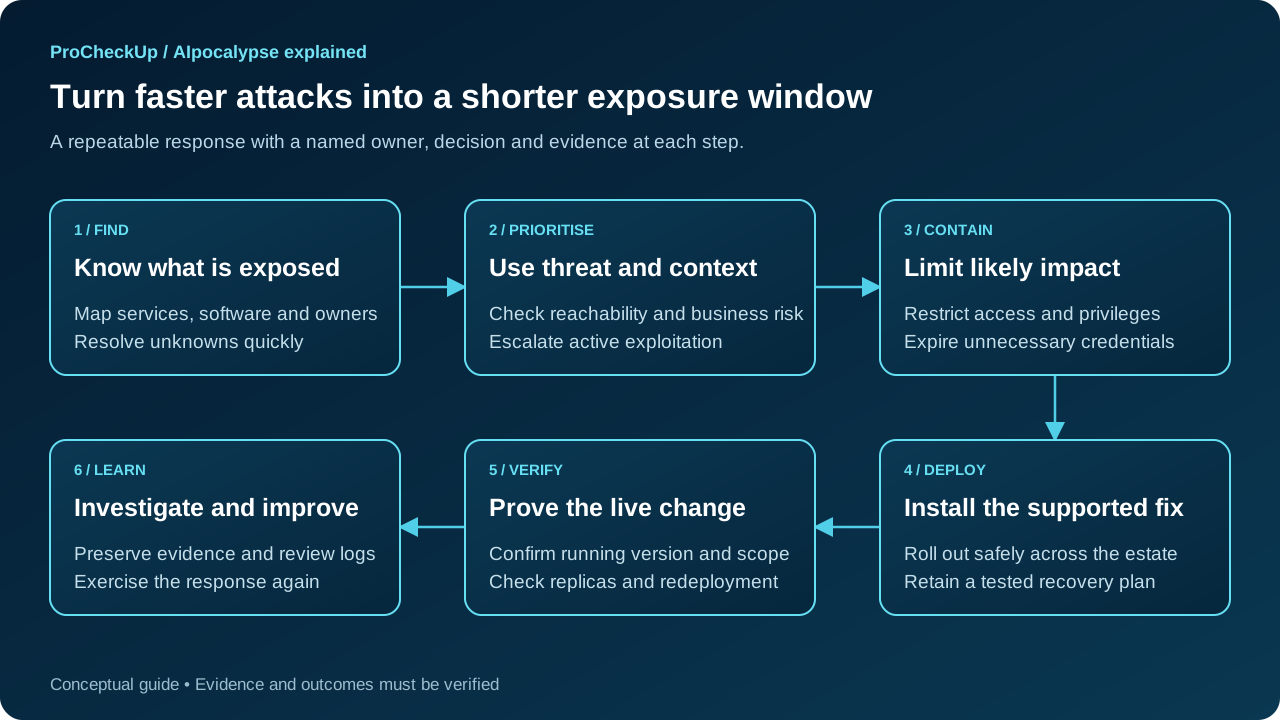
- Find the affected, reachable estate. Map external services to software, versions, owners and suppliers. Include bundled runtimes, appliances, containers, failover systems and temporary environments. An incomplete inventory is an unresolved task, not evidence of safety.
- Prioritise with threat and business context. Check vendor applicability, external reachability, privileges, sensitive data and credible exploitation reports. Use CISA’s Known Exploited Vulnerabilities catalogue as one input. A missing entry does not establish that a vulnerability is safe or unexploited.
- Reduce exposure when remediation cannot finish immediately. Consider restricting access, disabling an affected feature or isolating a service, using vendor-supported guidance and an explicit business decision. Record the owner, limitations and expiry. A generic WAF rule or network restriction is not automatically equivalent to fixing the vulnerable code.
- Deploy the supported fix safely. Verify the vendor package, test the critical service path and plan rollback or recovery. Work in controlled groups where appropriate. Include supplier-hosted systems and confirm who is responsible for completing the change.
- Verify what is actually running. An installed package, rebuilt image or successful change ticket does not prove all workloads restarted on the fixed version. Check the active service, replicas, routing and any required configuration. Retest relevant exposure and confirm that later redeployment or rollback cannot silently restore the vulnerable build.
- Keep possible compromise separate. Review the period before protection was effective. Preserve useful evidence, investigate suspicious actions and revoke exposed credentials where justified. Patching does not remove an established backdoor or invalidate stolen secrets.
For PCI DSS environments, align vulnerability risk ranking with Requirement 6.3.1. PCI SSC’s guidance states that patches for critical vulnerabilities must be installed within one month of release under Requirement 6.3.3, with other applicable updates addressed within risk-appropriate timeframes. That maximum is not a reason to defer an urgent internet-facing fix. Record the deployment and verification evidence, and arrange relevant rescanning or testing for the finding and change. PCI SSC vulnerability-management guidance.
Look for connected behaviour, not an “AI fingerprint”
Fast requests alone can come from ordinary automation, while an AI-assisted operation may pause for hours or days. Tool names, user agents and source IPs can change. Correlate activity by account, token, workload and target: unusual discovery followed by access changes, new credentials, unexpected command execution or outbound transfers. Use investigation context before concluding that a model was involved.
Retain identity, cloud-audit, endpoint, application and network evidence with synchronised timestamps. Include successful actions as well as failures. Keep an immediate view for bursts and a longer lookback for activity distributed across sessions. Where exposure or compromise is suspected, preserve evidence and coordinate containment with service owners rather than allowing a patch rollout to obscure the investigation.
For your own security agents, log the objective, approved scope, tool requests, actual executions and outcomes in a system the agent cannot rewrite. Give agents short-lived, narrowly scoped credentials and isolated working environments. Enforce network, privilege and data-handling boundaries in the surrounding systems. Treat repository content, web pages and tool output as untrusted input: hostile instructions in them must not expand the agent’s authority. Test that revoking access or stopping a run also stops queued tasks, child workers and external jobs. These controls support legitimate AI-assisted testing as well as resilience against stolen automation credentials. Apply data-minimisation and access controls to the logs themselves. OWASP AI Agent Security guidance.
Common questions
Are these frameworks malicious software?
They can support legitimate, authorised security testing. Malicious use depends on the operator and activity. A licence or authorised-use statement does not itself enforce consent, and a tool’s presence alone does not prove an intrusion.
Can an AI now find and exploit any zero-day?
No. Published demonstrations show important advances in particular settings. Software access, model capability, tools, human expertise and application conditions affect the result. A claimed finding still needs evidence of reachability and impact.
Does publishing a patch make users less safe?
A fix protects users when it is applied. Attackers may learn from the change, which makes prompt deployment and exposure reduction important. Suppressing or delaying a supported repair leaves the underlying weakness in place.
Should we wait for a public exploit before patching?
No. Use the advisory, applicability, exposure and impact to make the decision. Public exploit availability is an additional signal, not a prerequisite for a credible risk. Public code can also be incomplete, misleading or unsafe.
Do we need to buy an autonomous defensive agent?
Start with the bottleneck you need to fix: missing asset ownership, slow deployment, weak identity controls or poor verification. AI can assist those tasks, but a new agent also needs restricted access, reliable records and measured acceptance criteria.
How should an authorised assessment change?
Keep written scope and safety limits, then test relevant attack paths and defensive decisions. Ask the assessor which actions are automated, how destinations and credentials are constrained, how findings are validated and how all delegated work is stopped. The deliverable should explain proven impact and practical remediation, not just generated output.
Primary sources and review limits
This article combines the cited research with ProCheckUp’s defensive assessment. We have not independently reproduced the reported attacks or benchmarked the frameworks. Vendor telemetry has partial visibility, repository features change, and controlled demonstrations do not establish universal real-world success. No original exploit code is needed to understand or act on the risks described here.
Research sources and related ProCheckUp guidance
- Google GTIG — November agentic threat update
- Google GTIG — ARTEX and related frameworks
- Elastic — framework source review
- Elastic — AWS intrusion evidence and attribution limits
- Akamai — root-cause analysis and a supervised crash demonstration
- Project Zero — disclosure policy, 13 November 2026
- Anthropic — disclosure policy, 16 November 2026
- NCSC — AI threat assessment
- ProCheckUp — PHP2Shell
- ProCheckUp — Linux kernel TCP risk
- ProCheckUp — Java4Shell
- Cyber maturity assessment explained
How quickly can you establish and reduce exposure?
ProCheckUp can help review your external attack surface, validate significant findings and assess remediation priorities. We can also test AI-enabled applications and the boundaries around connected tools. Bring your service inventory, ownership gaps and response objectives to a scoped discussion.
Categories