
Java4Shell (CVE-2026-114938): Fixed Builds, Mitigation and Checks
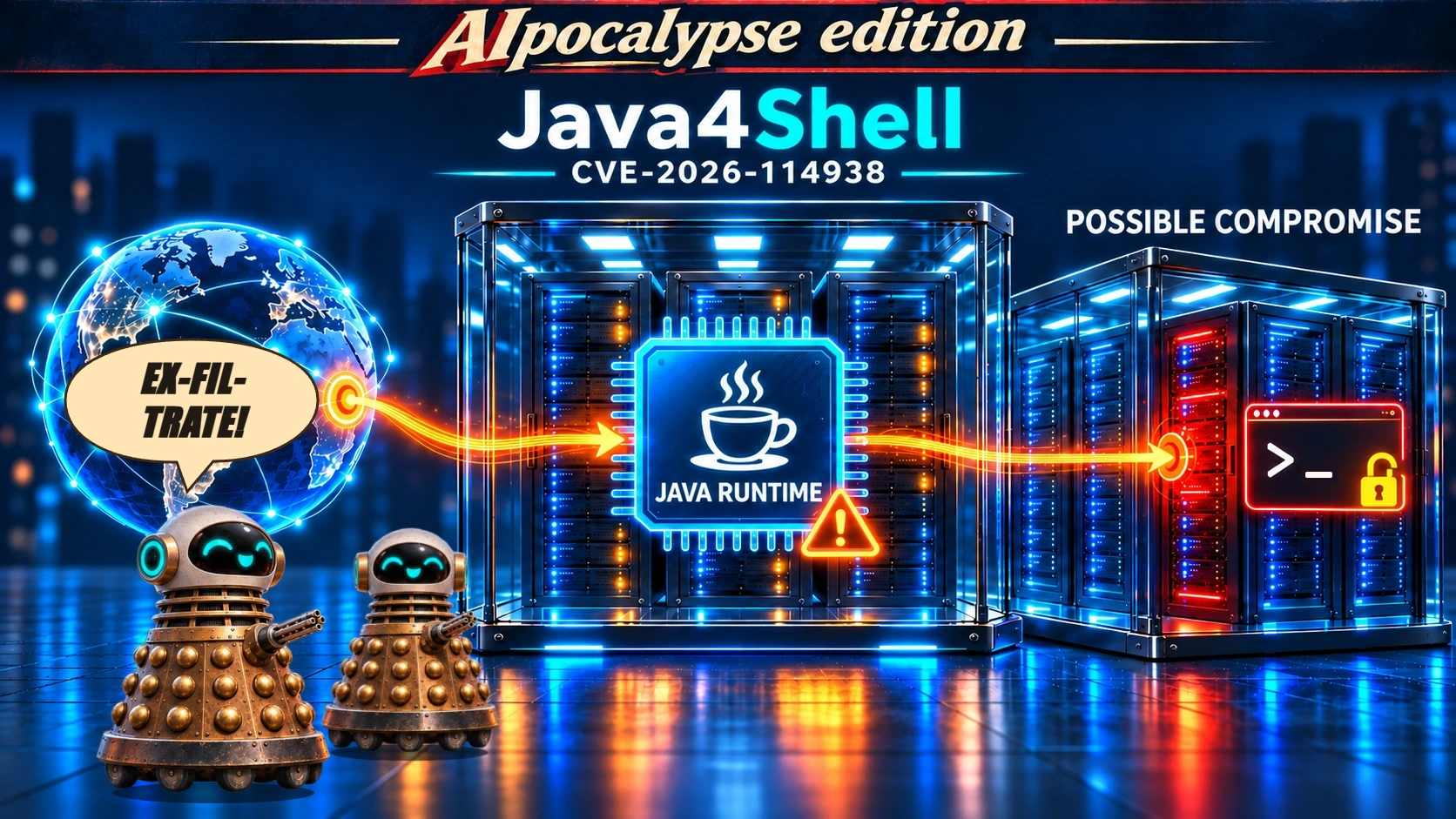
Java4Shell (CVE-2026-114938) is a memory-corruption vulnerability in HotSpot’s accelerated Base64 decoder. Researcher Calif reports unauthenticated remote code execution (RCE) against several enterprise applications in tested configurations. Prioritise exposed identity and build services, confirm the Java runtime and CPU features in use, then deploy a vendor-fixed runtime or a tested temporary mitigation.
Research checked: 18 November 2026, 01:20 GMT. Disclosure is official. Vendor releases are changing quickly. This article separates the vulnerable code, demonstrated attack paths and evidence of exploitation. OpenJDK advisory · Oracle November advisory.
Go straight to the verified fixed-build matrix for your Java distribution.
Patch and verify
Affected runtimes and confirmed fixed builds
Find your runtime vendor below, then confirm the supported update for your own product and package stream.
Last verified: 18 November 2026, 01:20 GMT. This is a dated snapshot; vendor releases can change.
| Runtime | Verified position | Action |
|---|---|---|
| Oracle Java SE | The CVE row lists affected builds 17.0.21.0.3, 21.0.13.0.3, 25.0.5.0.3, 27.0.1.0.3 and 8u511b33-perf. | Oracle’s replacement JDK releases include 17.0.21.1+4, 21.0.13.1+4, 25.0.5.1+4 and 27.0.1.1+4. For Java 8 Performance Pack, Oracle lists the fixed 8u513-perf release (1.8.0_513-perf-b4). Check the supported product update path before replacing a bundled runtime. |
| Amazon Corretto | Vendor changelogs explicitly list CVE-2026-114938 fixes in 17.0.21.1.2, 21.0.13.1.2, 25.0.5.1.2 and 27.0.1.1.4. | Use the matching Corretto release and package stream. Amazon Linux 2023 has corresponding advisories. Retain the matching release or package advisory as fix evidence. |
| Azul Zulu | November’s release explicitly fixes this CVE. Community PSU builds include 17.70.201, 21.54.201, 25.38.201 and 27.30.201. | Select the correct supported release family. Subscription and CPU branches have separate build identifiers. |
| Temurin | The checked Linux x64 HotSpot JDK release API still returned pre-fix builds on these branches. Its schedule listed replacement versions as “Next Release Due”. | Check the actual release for your operating system, architecture and JDK/JRE variant. A scheduled release does not establish binary availability. |
| Red Hat OpenJDK | The checked bulletin says fixes are being expedited. This review did not verify a fixed package erratum. | Follow the erratum for your product and package stream. Apply a tested temporary mitigation while a supported update is pending. |
| Debian packages | The tracker listed OpenJDK 17, 21, 25 and 27 source packages as vulnerable, with no fixed package version recorded at this check. | Use the distribution’s security tracker and repository. An upstream fix does not prove your installed distribution package contains it. |
| Microsoft, Liberica and SapMachine | This review did not verify exact CVE-specific fixed builds for these distributions. | Obtain a vendor statement explicitly covering CVE-2026-114938 for your exact build. “Not verified here” does not mean no fix exists. |
| GraalVM and product-bundled Java | Oracle’s matrix includes specified GraalVM JDK 17/21 and GraalVM Enterprise builds. Enterprise applications can ship private JVMs. | Follow the runtime and application vendor’s supported update path. Replacing the operating system’s default Java may leave a bundled runtime exposed. |
Affected-version boundaries and the Java 8 Performance Pack exception
The OpenJDK matrix marks Java 17, 21, 25 and 27 for this CVE. The vulnerable path was introduced into Java 17 at 17.0.6. Older vulnerable builds also need attention; the affected versions listed in the table are not an exhaustive list of every exposed build. Standard OpenJDK 8 and 11 do not contain the described vulnerable path, according to Red Hat’s bulletin. They still need the security updates applicable to their own releases. Oracle Java 8 Performance Pack is an important exception: its JDK 17-based JVM makes the listed 8u511b33-perf build relevant. Do not use “Java 8” alone to clear a finding.
Temurin API checks: 17, 21, 25, 27. Fixed Oracle build references: JDK 17, JDK 21, JDK 25, JDK 27. Check current vendor guidance before deploying.
Avoid the version-comparison trap. A Corretto build suffix can be numerically higher than an affected Oracle suffix while still predating the fix. Compare a build with its own vendor’s advisory. Fixes for the older Base64 issue JDK-8321599 also do not establish coverage for Java4Shell.
Check unsupported interim Java releases separately. Their absence from a maintained-release matrix is not evidence that they lack the vulnerable code. Plan migration to a supported, fixed runtime.
The November update also fixes other Java vulnerabilities, including the separate compiler issue CVE-2026-114941 in listed Java 21, 25 and 27 builds. Disabling the Base64 intrinsic does not establish protection against those other flaws. OpenJDK’s full advisory.
Turn an installed update into a verified running fix
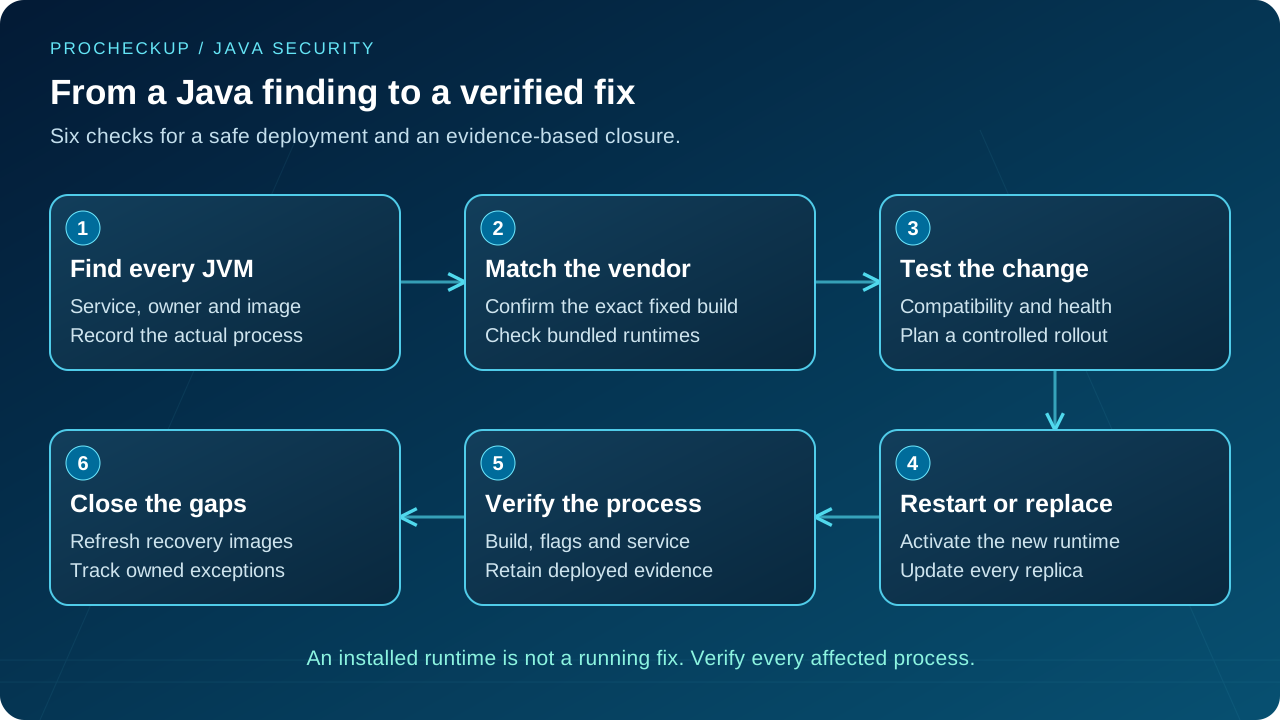
- Inventory applications and owners. Record executable path, vendor, complete build, service owner, node and image digest. Include scheduled jobs, disaster-recovery systems and private runtimes inside products.
- Match the supported fix. Retain the advisory, approved package and application compatibility guidance. Resolve scanner disagreements against the vendor’s build information.
- Test the deployment. Exercise sign-in, token processing, integrations and ordinary business operations in a representative environment. Confirm recovery access and a controlled rollback plan.
- Activate it everywhere. Restart affected JVMs or replace their containers. Rebuilding an image without replacing running instances leaves the old process active. Drain clustered services in a planned sequence.
- Verify the running process. Record its actual JVM build or active mitigation, deployment time and service health. Check every replica and node rather than a single healthy instance.
- Prevent reintroduction. Refresh base images, autoscaling templates, build agents and recovery copies. Give each exception an owner and review deadline. A rollback to the previous runtime may restore exposure.
PCI DSS: risk ranking, patch deadlines and retesting
For PCI DSS in-scope Java systems, record an environment-specific risk ranking under Requirement 6.3.1, considering exposure and potential impact on the payment environment. Under PCI DSS v4.0.1 Requirement 6.3.3, patches for vulnerabilities ranked critical must be installed within one month of release. Other applicable patches follow justified, risk-based timeframes; a lower external CVSS score does not decide your local ranking. The one-month limit is not a reason to delay an urgent, high-impact exposure. PCI SSC’s risk-ranking and patch guidance.
Keep the vendor advisory, running-build evidence, deployment date, owner and any verified interim setting. Disabling an intrinsic is risk reduction, not evidence that a vendor patch is installed or automatic proof of compliance. Confirm resolution of high-risk and critical internal-scan findings through rescans under 11.3.1. Where penetration testing identified an exploitable weakness, 11.4.4 requires correction according to assessed risk and repeated testing to verify it. A routine Java patch does not automatically require a full penetration test. PCI DSS v4.0.1 requirements.
Establish exposure
What goes wrong?
A specialised AVX-512 Base64 decoding routine mishandles malformed input near its end, writing beyond the allocated Java array. Rejecting that input afterwards comes too late to prevent memory corruption. Calif reports both heap disclosure and application-specific code-execution chains. Technical validation.
HotSpot is the Java Virtual Machine (JVM) used by many Java distributions. This is a runtime defect: a normally memory-safe Java application can reach unsafe native implementation code through a library API. A successful chain runs with the Java process’s privileges; it does not automatically mean operating-system root access. Service accounts, accessible secrets, deployment credentials and network permissions determine how far an intruder could proceed.
Authentication components can decode credentials or tokens before validating them. A login requirement therefore does not, by itself, prevent untrusted input reaching this routine. Assess the actual input path. Red Hat’s explanation of pre-authentication exposure.
Which workloads need urgent attention?
Assess the combination of an affected runtime, the necessary CPU features, an enabled accelerated decoder and a path by which untrusted data reaches it. The required x86-64 flags are avx512f, avx512bw, avx512vbmi and bmi2; all four matter. ARM64 does not execute the described vulnerable path. Calif’s explicit CPU-feature requirements.
| Family | Relevance to the described path |
|---|---|
| Intel Xeon Ice Lake, Sapphire Rapids, Emerald Rapids and Granite Rapids | Families named in Calif’s applicability guidance; confirm all four features exposed to the JVM. |
| AMD EPYC / Ryzen Zen 4 and newer | Also named by Calif. Include relevant servers and client workloads. |
| Selected Intel Ice Lake, Tiger Lake and Rocket Lake clients | VulnCheck identifies these client generations as possible AVX-512-capable exceptions. Do not limit inventory to servers. |
| Xeon Skylake-SP, Cascade Lake and Cooper Lake | These older server families lack VBMI; AVX-512 support alone is insufficient for this path. |
Sources: Calif, VulnCheck’s hardware analysis and GCC’s processor feature definitions. Hypervisors can mask features. Check the workload’s actual environment and reassess after migration.
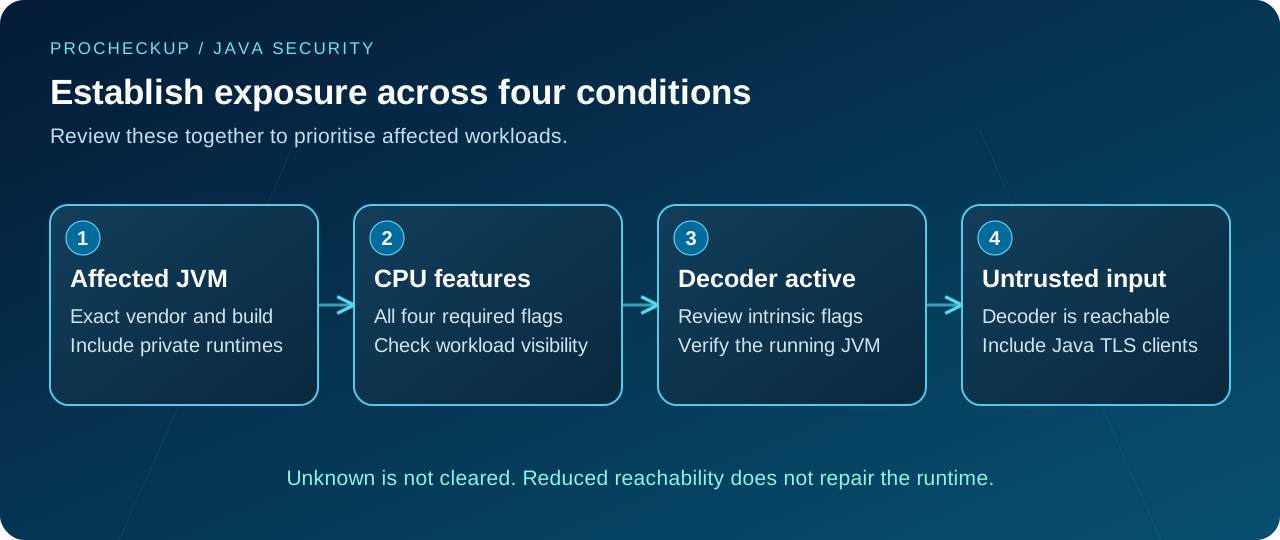
Our operational priority is exposed identity, CI/CD and administrative services first. Follow with other reachable Java applications and internal services accepting untrusted data. Assess business impact, privileges and access to credentials alongside internet reachability. Internal placement alone does not establish that input is trusted.
Do not overlook Java clients making outbound connections. Server-only inventories can miss them. In virtualised and container estates, inspect the CPU features exposed to the workload and evaluate every relevant node. A change of host or instance type can change applicability without changing the application image.
Read-only checks for the running JVM and CPU
Use approved inventory tools and the service owner’s access. On supported HotSpot deployments, use the same effective user and group as the JVM, the correct process-ID namespace and an appropriate JDK tool installation. Substitute the actual process ID:
jcmd <PID> VM.version
jcmd <PID> VM.flags -all
Record the complete runtime identity. In the flags output, check UseBASE64Intrinsics and, where supported, UseAVX. UseBASE64Intrinsics = true permits the JIT optimisation; it does not prove that every decode uses it. An idle or newly started process is not a reliable reason to clear exposure. These commands inspect the selected process; a separate java -version in your shell may inspect a different installation. Oracle jcmd documentation.
On Linux, this inventory query reports the relevant CPU flags exposed in the current environment:
grep -m1 '^flags' /proc/cpuinfo | tr ' ' '\n' | grep -E '^(avx512f|avx512bw|avx512vbmi|bmi2)$'- Check the correct boundary. Inspect the host, guest or container where the JVM runs. Repeat across mixed-node clusters and relevant deployment targets.
- Record limitations. Missing
jcmd, denied attach access, unavailable CPU information or an unsupported flag leaves that part of the assessment unknown. It does not prove that the service is safe. - Separate configuration from remediation. CPU output alone does not prove the decoder is enabled or reachable. An active mitigation does not turn an unpatched build into a vendor-fixed build.
How should we interpret the severity scores?
| Source | Score | Interpretation |
|---|---|---|
| OpenJDK / Oracle | CVSS v3.1: 8.1 High | Network reachable, no required privileges or user action, high attack complexity and potentially high impact. |
| Amazon Linux | CVSS v3.1: 8.8 High; vendor priority “Important” | Its vector assumes low complexity and low required privileges, unlike Oracle’s high-complexity, unauthenticated assessment. Keep the product context beside the score. |
| Calif | CVSS v4.0: 9.2 Critical | A different scoring version. Treat it as a separate assessment, not evidence that Oracle’s v3.1 score changed. |
Oracle’s vector is CVSS:3.1/AV:N/AC:H/PR:N/UI:N/S:U/C:H/I:H/A:H. This is a heap out-of-bounds write. Canada’s Cyber Centre classifies it as CWE-122; the CVE record’s CISA ADP enrichment also supplies that classification. Oracle’s CNA provides the score. At 01:12 GMT on 18 November 2026, NVD’s page and API showed the record as “Received” with Oracle’s 8.1 score and no independent NVD assessment. Published CVE record · NVD page · NVD API.
For incident planning, prioritise a reachable, privileged service with a demonstrated attack path urgently. High attack complexity is a scoring condition, not an assurance that your organisation has time to wait.
Evidence and temporary controls
What has actually been demonstrated?
Calif reports pre-authentication RCE in tested Keycloak, Jira, Confluence, Artifactory, Jenkins and PingFederate configurations; authenticated RCE in other products; and sample Struts/Spring Boot applications. It also describes a separate malicious-server route affecting Java TLS clients. These are reported research results, not a claim about every product version or deployment. Calif’s demonstrations and limitations.
Availability impact matters even without a working RCE chain. Blackpoint reports a JVM crash in a local Spring Boot test with HTTP Basic authentication explicitly enabled: approximately 28,300 unauthenticated requests were sent over roughly 20 seconds. VulnCheck independently reports that request bursts could crash a reachable vulnerable decoder. These are lab observations, not universal request thresholds or proof of RCE. Assess and report the availability risk on its own merits. Blackpoint’s test scope · VulnCheck’s reproduction.
Published research is different from released exploit chains. Calif has published a limited reproducer while withholding its product-specific exploit chains. We have not independently reproduced the RCE or verified every third-party exploit claim. Do not run memory-corruption reproducers against production.
The live CISA KEV feed checked for this article contained no entry for this CVE. The downloaded feed was dated 17 November 2026, 17:53 GMT; it is not a real-time account of attacks. The reviewed primary material did not establish in-the-wild exploitation. Those observations are a dated evidence check, not proof that no attacks have occurred.
What can you do if the supported update is not ready?
The targeted temporary option is to start the affected JVM with:
-XX:-UseBASE64IntrinsicsThis disables the accelerated Base64 implementation. Test the application and performance, deploy the setting through the actual service configuration, then restart or recreate the workload. Confirm UseBASE64Intrinsics = false in the running JVM’s flags. Keep a vendor-fixed update in the remediation plan. After verifying that fix, review whether the temporary flag can be removed safely so it does not become an undocumented permanent setting.
The standalone flag is recommended by Calif and Red Hat and worked in Upwind’s published testing. VulnCheck tested it together with -XX:+UnlockDiagnosticVMOptions. That extra switch enables diagnostic options; it does not itself disable Base64 and is not universally required; OpenJDK defines UseBASE64Intrinsics as a product flag. OpenJDK flag definitions. If your runtime rejects a setting, follow that vendor’s exact supported sequence and verify startup and the active flag. VulnCheck’s tested options.
An alternative on x86-64 is -XX:UseAVX=2, which restricts AVX more broadly. Avoid distributing it blindly to ARM services: their JVM may reject the option and fail to start. Follow the runtime supplier’s guidance. Red Hat mitigation guidance.
- Control reachability. Restrict administrative and build services to approved access paths where practical. Confirm that business integrations still work.
- Check per-service deployment. A flag added to one launcher or environment does not establish coverage for another process, embedded JVM or future replica.
- Avoid incomplete flag recipes. Do not copy alternative intrinsic-disable options without their required JVM prerequisites and vendor validation.
- Do not clear exposure based on a proxy. Buffering or filtering may alter an attack path, but there is no universal proxy or WAF fix for the runtime defect. Assess upgraded connections and non-HTTP clients too.
Detection and incident response
Upwind’s published analysis suggests correlating unusual Base64-shaped inputs, bursts of decoder exceptions and unexplained JVM failures. Its heuristic includes Base64-alphabet values of at least 32 characters that end in = and have a length that is not a multiple of four. Measure the value being decoded, rather than an entire header containing a transport prefix. Apply it to fields your application actually decodes, including authentication inputs where appropriate. Upwind’s technical validation and detection guidance.
- Application evidence. Correlate bursts of
IllegalArgumentExceptionevents whose stack traces includejava.util.Base64$Decoderwith request source, endpoint and time. Normal malformed input can produce the same exception. - Process evidence. Review unexpected
hs_err_pid*.logfiles, crash loops, changed JVM restart rates and unusual child processes. Hadrian’s hunting guidance includes Linux containers exiting with134or139; treat these as crash-triage signals, not Java4Shell-specific indicators. Correlate them with JVM fatal-error logs and request timing. Successful attacks do not have to leave a crash. Hadrian’s observations and hunting guidance. - Operational context. Compare alerts with deployments, health checks, service account activity, outbound connections and changes to build or identity configuration.
- Handle logs carefully. Avoid capturing complete credentials or authentication tokens while adding detection. Limit collection, access and retention to what the investigation needs.
No individual symptom proves Java4Shell exploitation, and quiet logs do not prove safety. If evidence suggests compromise, preserve available telemetry and engage incident response. Assess whether secrets accessible to the process need revocation or rotation, including signing keys and deployment credentials. Coordinate rotation and recovery so that dependent services continue to work. Installing a fixed JVM does not remove an existing backdoor or invalidate stolen tokens.
Questions and sources
Frequently asked questions
Is this Log4Shell or a Log4j vulnerability?
No. Java4Shell is the name used for this HotSpot Base64 memory-corruption issue. Updating Log4j alone does not replace the vulnerable JVM implementation.
Does a container image scan prove the service is fixed?
It helps inventory the image. You still need to verify which image and JVM are running in every instance, whether the application uses another bundled runtime, and whether the latest deployment has replaced old processes.
Is an ARM deployment unaffected?
ARM64 does not use the described AVX-512 path. Record that hardware evidence and continue ordinary Java security updates. Do not extend the conclusion to mixed x86 fleets or future host migrations.
Can an outbound-only Java application be relevant?
Yes. The research describes a Java TLS-client route involving a malicious server. Include client applications and integrations in the runtime inventory rather than limiting the review to listening web services.
Must the server be rebooted?
The affected component is the JVM, so the updated or mitigated Java process must be started. A host reboot may be your chosen deployment method, but the essential check is that every affected JVM actually uses the intended runtime or flag.
What should we ask a hosting or software supplier?
Request the application’s runtime vendor and full build, the advisory covering this CVE, hardware applicability, deployment completion time and evidence for all replicas. If a mitigation is used, ask how it is verified and when a supported fixed build will replace it.
Primary sources and review limits
This article combines current primary advisories with ProCheckUp’s operational assessment. It does not certify a particular installation. We have not verified every distributor’s fixed package, every product-specific chain, or the absence of attacks. Recheck the vendor’s current entry before closing a finding.
CISA’s 17 November alert and Canada’s AL26-029 reinforce the need to inventory affected applications and apply appropriate vendor updates promptly.
View the research sources
- OpenJDK security advisory — 17 November 2026
- Oracle November 2026 Critical Security Patch Update
- CVE record and NVD record
- Calif — original Java4Shell research
- Upwind — independent runtime testing and operational indicators
- Red Hat CVE and mitigation guidance
- Amazon Linux advisory index and Corretto 17 release changelog
- Oracle jcmd command reference
- CISA — critical Java vulnerability alert, 17 November
- Canadian Cyber Centre — AL26-029
- Blackpoint — JVM crash and disclosure testing
- VulnCheck — exploitation limits, hardware and mitigation testing
- Hadrian — runtime testing and crash-triage guidance
- PCI SSC FAQ 1597
- CISA live KEV feed
Need to establish your Java exposure?
ProCheckUp can help assess externally reachable services, review remediation priorities and verify security improvements. Bring your application inventory, runtime details and vendor advisories to a scoped discussion.
Categories